Myrmecophagy: Difference between revisions
CSV import |
CSV import |
||
| Line 39: | Line 39: | ||
{{Animal behavior}} | {{Animal behavior}} | ||
{{food-stub}} | {{food-stub}} | ||
<gallery> | |||
File:Gr._Ameisenbär_auf_Futtersuche.JPG|Giant Anteater foraging | |||
File:Picus_viridis_sharpei_115.jpg|Iberian Green Woodpecker | |||
File:AntSpider.jpg|Ant-mimicking Spider | |||
</gallery> | |||
Latest revision as of 21:00, 25 February 2025
Myrmecophagy refers to the dietary behavior of certain animals that primarily feed on ants and termites. This term is derived from the Greek words 'myrmex' meaning ant and 'phagein' meaning to eat. Myrmecophagy is observed in a variety of animal species, including mammals, birds, and reptiles.
Overview[edit]
Myrmecophagy is a specialized form of insectivory, where the diet consists mainly of ants and termites. This feeding behavior has evolved in several distinct animal lineages. Myrmecophagous animals have developed unique adaptations to deal with the defensive mechanisms of ants and termites, such as their bites, stings, and chemical defenses.
Myrmecophagous Animals[edit]
Several animal species are known for their myrmecophagous behavior. These include the anteater, pangolin, aardvark, and echidna. Some bird species, such as the antbird and woodpecker, also exhibit myrmecophagy. Certain reptiles, like the horned lizard, are also myrmecophagous.
Anteaters[edit]
Anteaters are perhaps the most well-known myrmecophagous animals. They have long, sticky tongues that they use to collect ants and termites from their nests. Anteaters also have sharp claws to break open ant and termite mounds.
Pangolins[edit]
Pangolins, also known as scaly anteaters, are another group of myrmecophagous mammals. They use their long, sticky tongues to collect ants and termites, similar to anteaters. However, pangolins are unique in having protective scales made of keratin.
Aardvarks[edit]
Aardvarks are large, nocturnal mammals that feed primarily on ants and termites. They use their powerful claws to dig into ant and termite mounds, and their long, sticky tongues to collect the insects.
Echidnas[edit]
Echidnas, or spiny anteaters, are monotremes that feed on ants and termites. They have a long, sticky tongue and sharp spines for protection.
Adaptations[edit]
Myrmecophagous animals have evolved several adaptations to deal with the defensive mechanisms of ants and termites. These include physical adaptations, such as long, sticky tongues and sharp claws, as well as behavioral adaptations, such as nocturnal activity patterns to avoid the heat of the day when ants and termites are most active.
See Also[edit]
| Animal behavior | ||||||||
|---|---|---|---|---|---|---|---|---|
This animal behavior related article is a stub.
|

-
 Giant Anteater foraging
 -
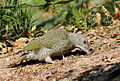 Iberian Green Woodpecker
 -
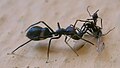 Ant-mimicking Spider


