Krypton: Difference between revisions
CSV import |
CSV import |
||
| Line 42: | Line 42: | ||
{{stub}} | {{stub}} | ||
== Krypton == | |||
<gallery> | |||
File:William_Ramsay_working.jpg|William Ramsay working in his laboratory | |||
File:Krypton_hydride_crystal.jpg|Krypton hydride crystal | |||
File:Krypton_hydride_structure.png|Krypton hydride structure | |||
File:KrTube.jpg|Krypton gas in a discharge tube | |||
File:The_Meyer-Overton_correlation.png|The Meyer-Overton correlation | |||
</gallery> | |||
Latest revision as of 04:57, 18 February 2025
Krypton is a chemical element with the symbol Kr and atomic number 36. It is a member of group 18 (noble gases) elements. A colorless, odorless, tasteless noble gas, krypton occurs in trace amounts in the atmosphere and is often used with other rare gases in fluorescent lamps. Krypton is typically used in high-speed photography, fluorescent lamps, and as a radiometric dating method.
Characteristics[edit]
Krypton is characterized by several spectral lines that are very sharp and distinct. The spectral lines of krypton are easily produced and some are very bright. Krypton is one of the products of uranium fission. Other characteristics include:
- It is a colorless, odorless, tasteless, and noble gas that occurs in trace amounts in the atmosphere.
- It is used in some types of photographic flashes used in high-speed photography.
- Krypton is used in fluorescent lamps where it has many spectral lines, and krypton mixed with argon is used in energy-saving fluorescent lamps.
- Krypton is used as the filling gas in many types of high-voltage equipment.
History[edit]
Krypton was discovered in Britain in 1898 by Sir William Ramsay, a Scottish chemist, and Morris Travers, an English chemist, in residue left from evaporating nearly all components of liquid air. The name of the element is derived from the Greek word 'Kryptos', meaning hidden.
Isotopes[edit]
There are 33 known isotopes of krypton with atomic mass numbers from 69 through 101. Naturally occurring krypton is made of five stable isotopes and one slightly radioactive isotope, the most stable being 83Kr, 85Kr, and 86Kr. The isotope 81Kr has been used for dating old (50,000- to 800,000-year-old) groundwater.
Applications[edit]
Krypton's most important use is in lighting products. Many of the krypton's uses take advantage of its low reactivity and high light emission. Some of the applications include:
- Photographic flashes: Krypton is used in some types of photographic flashes used in high-speed photography.
- Fluorescent lamps: Krypton is used in fluorescent lamps where it has many spectral lines, and krypton mixed with argon is used in energy-saving fluorescent lamps.
- High-voltage equipment: Krypton is used as the filling gas in many types of high-voltage equipment.
See also[edit]
References[edit]
<references />
 |
 |
Krypton[edit]
-
 William Ramsay working in his laboratory
 -
 Krypton hydride crystal
 -
 Krypton hydride structure
 -
 Krypton gas in a discharge tube
 -
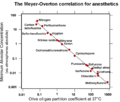 The Meyer-Overton correlation


