Fileja: Difference between revisions
CSV import Tags: mobile edit mobile web edit |
No edit summary |
||
| Line 23: | Line 23: | ||
{{Italian-cuisine-stub}} | {{Italian-cuisine-stub}} | ||
{{food-stub}} | {{food-stub}} | ||
<gallery> | <gallery> | ||
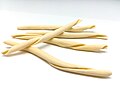
File:Fileja.jpg|Fileja | File:Fileja.jpg|Fileja | ||
</gallery> | </gallery> | ||
Latest revision as of 21:52, 16 March 2025
Fileja is a type of pasta originating from the Calabria region of Italy. It is a traditional pasta shape, often homemade, and is typically served with a variety of sauces, including tomato sauce, ragù, and pesto.
History[edit]
The origins of Fileja are deeply rooted in the culinary tradition of Calabria. This pasta shape is believed to have been created by the ancient inhabitants of the region, who used a thin iron rod to shape the pasta. The name "Fileja" is derived from the local dialect, and it refers to the method of rolling the pasta around a thin rod or wire.
Preparation[edit]
Fileja is made from a simple dough of wheat flour, water, and sometimes a small amount of olive oil. The dough is rolled out into thin ropes, then wrapped around a thin rod or wire to create a spiral shape. The pasta is then left to dry before it is cooked.
Serving[edit]
Fileja is typically served with robust, hearty sauces. In Calabria, it is often paired with a ragù made from local pork or goat meat. It can also be served with a simple tomato sauce, or with a pesto made from the region's famous red onions.
See also[edit]

This article is a Italian-cuisine stub. You can help WikiMD by expanding it!
This Italian cuisine related article is a stub. You can help WikiMD by expanding it.

-
 Fileja

