Epstein syndrome: Difference between revisions
CSV import |
CSV import |
||
| Line 1: | Line 1: | ||
{{SI}} | |||
{{Infobox medical condition | |||
| name = Epstein syndrome | |||
| image = [[File:Giant_Platelet,_Peripheral_Blood_Smear_(6032662354).jpg|left|thumb|Giant platelet in peripheral blood smear]] | |||
| caption = Giant platelet in peripheral blood smear | |||
| field = [[Hematology]] | |||
| symptoms = [[Thrombocytopenia]], [[nephritis]], [[hearing loss]] | |||
| complications = [[Kidney failure]], [[bleeding disorders]] | |||
| onset = Usually in [[childhood]] | |||
| duration = [[Chronic (medicine)|Chronic]] | |||
| causes = Genetic mutation in the [[MYH9]] gene | |||
| risks = Family history of the condition | |||
| diagnosis = [[Blood test]], [[urinalysis]], [[genetic testing]] | |||
| differential = [[Alport syndrome]], [[Fechtner syndrome]], [[Sebastian syndrome]] | |||
| treatment = [[Symptomatic treatment]], [[dialysis]], [[kidney transplant]] | |||
| prognosis = Variable, depends on severity of symptoms | |||
| frequency = Rare | |||
}} | |||
'''Epstein syndrome''' is a rare [[genetic disorder]] characterized by [[thrombocytopenia]], [[nephritis]], and [[sensorineural hearing loss]]. It is an autosomal dominant disorder, meaning that only one copy of the altered gene is necessary for the disorder to occur. | '''Epstein syndrome''' is a rare [[genetic disorder]] characterized by [[thrombocytopenia]], [[nephritis]], and [[sensorineural hearing loss]]. It is an autosomal dominant disorder, meaning that only one copy of the altered gene is necessary for the disorder to occur. | ||
== Symptoms == | == Symptoms == | ||
The primary symptoms of Epstein syndrome include [[thrombocytopenia]], or low platelet count, which can lead to increased bleeding and bruising; [[nephritis]], or inflammation of the kidneys, which can lead to kidney damage and failure; and [[sensorineural hearing loss]], which is a type of hearing loss in which the root cause lies in the inner ear or sensory organ (cochlea and associated structures) or the vestibulocochlear nerve (cranial nerve VIII). | The primary symptoms of Epstein syndrome include [[thrombocytopenia]], or low platelet count, which can lead to increased bleeding and bruising; [[nephritis]], or inflammation of the kidneys, which can lead to kidney damage and failure; and [[sensorineural hearing loss]], which is a type of hearing loss in which the root cause lies in the inner ear or sensory organ (cochlea and associated structures) or the vestibulocochlear nerve (cranial nerve VIII). | ||
== Causes == | == Causes == | ||
Epstein syndrome is caused by mutations in the [[MYH9 gene]], which provides instructions for making a protein called nonmuscle myosin heavy chain IIA. This protein plays a crucial role in the movement and division of cells, as well as in the formation of [[platelets]], which are essential for normal blood clotting. | Epstein syndrome is caused by mutations in the [[MYH9 gene]], which provides instructions for making a protein called nonmuscle myosin heavy chain IIA. This protein plays a crucial role in the movement and division of cells, as well as in the formation of [[platelets]], which are essential for normal blood clotting. | ||
== Diagnosis == | == Diagnosis == | ||
Diagnosis of Epstein syndrome is typically based on the presence of the characteristic symptoms, a detailed patient history, a thorough clinical evaluation, and a variety of specialized tests. These tests may include complete blood count (CBC), kidney function tests, and hearing tests. Genetic testing can confirm a diagnosis. | Diagnosis of Epstein syndrome is typically based on the presence of the characteristic symptoms, a detailed patient history, a thorough clinical evaluation, and a variety of specialized tests. These tests may include complete blood count (CBC), kidney function tests, and hearing tests. Genetic testing can confirm a diagnosis. | ||
== Treatment == | == Treatment == | ||
Treatment of Epstein syndrome is directed toward the specific symptoms that are apparent in each individual. This may include platelet transfusions for thrombocytopenia, medications to manage nephritis, and hearing aids or cochlear implants for sensorineural hearing loss. | Treatment of Epstein syndrome is directed toward the specific symptoms that are apparent in each individual. This may include platelet transfusions for thrombocytopenia, medications to manage nephritis, and hearing aids or cochlear implants for sensorineural hearing loss. | ||
==Images== | |||
<gallery> | |||
File:Kidney_tubules.png|Kidney tubules in Epstein syndrome | |||
File:Peritoneal_dialysis.gif|Peritoneal dialysis in Epstein syndrome | |||
</gallery> | |||
== See also == | == See also == | ||
* [[Genetic disorder]] | * [[Genetic disorder]] | ||
* [[Thrombocytopenia]] | * [[Thrombocytopenia]] | ||
| Line 24: | Line 37: | ||
* [[Sensorineural hearing loss]] | * [[Sensorineural hearing loss]] | ||
* [[MYH9 gene]] | * [[MYH9 gene]] | ||
[[Category:Genetic disorders]] | [[Category:Genetic disorders]] | ||
[[Category:Rare diseases]] | [[Category:Rare diseases]] | ||
| Line 31: | Line 43: | ||
{{Rare diseases}} | {{Rare diseases}} | ||
[[Category:Syndromes]] {{stub}} | [[Category:Syndromes]] {{stub}} | ||
Latest revision as of 15:33, 6 April 2025

Editor-In-Chief: Prab R Tumpati, MD
Obesity, Sleep & Internal medicine
Founder, WikiMD Wellnesspedia &
W8MD medical weight loss NYC and sleep center NYC
| Epstein syndrome | |
|---|---|
.jpg) | |
| Synonyms | N/A |
| Pronounce | N/A |
| Specialty | N/A |
| Symptoms | Thrombocytopenia, nephritis, hearing loss |
| Complications | Kidney failure, bleeding disorders |
| Onset | Usually in childhood |
| Duration | Chronic |
| Types | N/A |
| Causes | Genetic mutation in the MYH9 gene |
| Risks | Family history of the condition |
| Diagnosis | Blood test, urinalysis, genetic testing |
| Differential diagnosis | Alport syndrome, Fechtner syndrome, Sebastian syndrome |
| Prevention | N/A |
| Treatment | Symptomatic treatment, dialysis, kidney transplant |
| Medication | N/A |
| Prognosis | Variable, depends on severity of symptoms |
| Frequency | Rare |
| Deaths | N/A |
Epstein syndrome is a rare genetic disorder characterized by thrombocytopenia, nephritis, and sensorineural hearing loss. It is an autosomal dominant disorder, meaning that only one copy of the altered gene is necessary for the disorder to occur.
Symptoms[edit]
The primary symptoms of Epstein syndrome include thrombocytopenia, or low platelet count, which can lead to increased bleeding and bruising; nephritis, or inflammation of the kidneys, which can lead to kidney damage and failure; and sensorineural hearing loss, which is a type of hearing loss in which the root cause lies in the inner ear or sensory organ (cochlea and associated structures) or the vestibulocochlear nerve (cranial nerve VIII).
Causes[edit]
Epstein syndrome is caused by mutations in the MYH9 gene, which provides instructions for making a protein called nonmuscle myosin heavy chain IIA. This protein plays a crucial role in the movement and division of cells, as well as in the formation of platelets, which are essential for normal blood clotting.
Diagnosis[edit]
Diagnosis of Epstein syndrome is typically based on the presence of the characteristic symptoms, a detailed patient history, a thorough clinical evaluation, and a variety of specialized tests. These tests may include complete blood count (CBC), kidney function tests, and hearing tests. Genetic testing can confirm a diagnosis.
Treatment[edit]
Treatment of Epstein syndrome is directed toward the specific symptoms that are apparent in each individual. This may include platelet transfusions for thrombocytopenia, medications to manage nephritis, and hearing aids or cochlear implants for sensorineural hearing loss.
Images[edit]
-
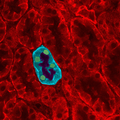 Kidney tubules in Epstein syndrome
 -
 Peritoneal dialysis in Epstein syndrome


See also[edit]
| Genetic disorders | ||||||||
|---|---|---|---|---|---|---|---|---|
This genetic disorder related article is a stub.
|
NIH genetic and rare disease info[edit]
Epstein syndrome is a rare disease.
| Rare and genetic diseases | ||||||
|---|---|---|---|---|---|---|
|
Rare diseases - Epstein syndrome
|


