Double-lumen endobronchial tube: Difference between revisions
No edit summary |
CSV import |
||
| Line 51: | Line 51: | ||
[[Category:Anesthesia]] | [[Category:Anesthesia]] | ||
[[Category:Thoracic surgery]] | [[Category:Thoracic surgery]] | ||
<gallery> | |||
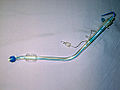
File:Carlens.jpg|Double-lumen endobronchial tube | |||
</gallery> | |||
Latest revision as of 01:01, 20 February 2025
Double-lumen Endobronchial Tube[edit]
A double-lumen endobronchial tube (DLT) is a specialized endotracheal tube used in anesthesia and thoracic surgery to achieve lung isolation. This allows for independent ventilation of each lung, which is crucial during certain surgical procedures such as lobectomy, pneumonectomy, and esophagectomy.
Design and Function[edit]
The double-lumen endobronchial tube is designed with two separate lumens: one for the trachea and one for the bronchus. Each lumen has its own cuff, allowing for selective inflation and deflation. This design enables the isolation of one lung from the other, facilitating procedures that require a collapsed lung on one side while maintaining ventilation on the other.
Components[edit]
- Tracheal Lumen: This lumen is positioned in the trachea and is used to ventilate the non-operative lung.
- Bronchial Lumen: This lumen is advanced into the mainstem bronchus of the lung that needs to be isolated.
- Cuffs: The tracheal and bronchial cuffs are inflated to secure the tube in place and prevent air leakage.
Indications[edit]
Double-lumen endobronchial tubes are indicated in situations where lung isolation is necessary. Common indications include:
- Thoracic surgery requiring one-lung ventilation
- Pulmonary hemorrhage
- Bronchopleural fistula
- Lung transplantation
Placement Technique[edit]
The placement of a double-lumen endobronchial tube requires skill and precision. The procedure is typically performed under general anesthesia.
1. Preparation: The patient is anesthetized and positioned appropriately. 2. Insertion: The DLT is inserted through the oral cavity and advanced into the trachea. 3. Positioning: The tube is rotated and advanced into the desired bronchus under bronchoscopic guidance. 4. Verification: Correct placement is confirmed using a fiberoptic bronchoscope.
Complications[edit]
While generally safe, the use of double-lumen endobronchial tubes can be associated with complications such as:
- Trauma to the airway
- Hypoxemia
- Bronchial rupture
- Malposition of the tube
Related Pages[edit]
| Anesthesia and anesthesiology | ||||||||||
|---|---|---|---|---|---|---|---|---|---|---|
|
-
 Double-lumen endobronchial tube

