Czapek medium: Difference between revisions
CSV import |
CSV import Tags: mobile edit mobile web edit |
||
| Line 56: | Line 56: | ||
[[Category:Microbiological media]] | [[Category:Microbiological media]] | ||
[[Category:Fungal culture media]] | [[Category:Fungal culture media]] | ||
<gallery> | |||
File:Aspergillus tubingensis FJBJ11.png|Aspergillus tubingensis FJBJ11 | |||
File:Aspergillus bertholletius - Journal.pone.0042480.g004.png|Aspergillus bertholletius | |||
File:Aspergillus fumigatus.jpg|Aspergillus fumigatus | |||
</gallery> | |||
Latest revision as of 05:18, 3 March 2025
Template:Infobox culture media
Czapek medium, also known as Czapek-Dox medium, is a type of growth medium used in microbiology for the cultivation of fungi and certain bacteria. It is particularly useful for growing Aspergillus and Penicillium species. The medium is named after the Czech botanist Friedrich Czapek, who developed it in the early 20th century.
Composition[edit]
Czapek medium is a defined, or synthetic, medium, meaning that all the chemical components are known. The standard formulation includes:
- Sucrose: 30 g/L
- Sodium nitrate (NaNO₃): 2 g/L
- Dipotassium phosphate (K₂HPO₄): 1 g/L
- Magnesium sulfate (MgSO₄·7H₂O): 0.5 g/L
- Potassium chloride (KCl): 0.5 g/L
- Ferrous sulfate (FeSO₄·7H₂O): 0.01 g/L
- Agar (for solid medium): 15 g/L
- Distilled water: 1 L
The pH of the medium is typically adjusted to 7.3 before sterilization.
Function and Use[edit]
Czapek medium is used primarily for the isolation and cultivation of fungi that can utilize nitrate as a sole nitrogen source. The medium's defined nature allows researchers to study the nutritional requirements and metabolic pathways of fungi. It is particularly useful in mycology for the identification and characterization of fungal species.
The presence of sucrose as the sole carbon source and sodium nitrate as the sole nitrogen source makes Czapek medium selective for organisms that can metabolize these compounds. This selectivity is advantageous in isolating fungi from mixed cultures or environmental samples.
Preparation[edit]
To prepare Czapek medium, dissolve the specified amounts of each component in distilled water. Adjust the pH to 7.3 using a suitable buffer or acid/base. If preparing a solid medium, add agar before autoclaving. Sterilize the medium by autoclaving at 121°C for 15 minutes. Once cooled, the medium can be poured into Petri dishes or used in liquid form for broth cultures.
Applications[edit]
Czapek medium is widely used in research and industrial applications involving fungi. It is employed in:
- Taxonomy and identification of fungal species
- Studies of fungal metabolism and physiology
- Screening for antibiotic production
- Environmental microbiology for isolating fungi from soil and other samples
Limitations[edit]
While Czapek medium is useful for many fungi, it is not suitable for all microorganisms. Some fungi and bacteria may not grow well on this medium due to its specific nutrient composition. Additionally, the medium does not support the growth of organisms that require complex nutrients or those that cannot utilize nitrate as a nitrogen source.
Also see[edit]
| Microbiology | ||||||||||
|---|---|---|---|---|---|---|---|---|---|---|
This microbiology related article is a stub.
|
-
 Aspergillus tubingensis FJBJ11
 -
 Aspergillus bertholletius
 -
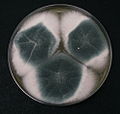 Aspergillus fumigatus


