Sabouraud agar
Sabouraud Agar is a type of agar medium used extensively in microbiology for the cultivation of fungi, particularly dermatophytes. It was created by Raymond Sabouraud in 1892, primarily for the study of skin fungal pathogens. The medium's low pH (approximately 5.6) inhibits the growth of most bacteria while allowing fungi to thrive, making it an ideal environment for mycological studies.
Composition[edit]
Sabouraud Agar consists of:
- Peptones: Provide nitrogen and vitamins necessary for fungal growth.
- Glucose: Serves as the primary energy source.
- Agar: A gelatinous substance that provides the medium's solid structure.
- Adjusted pH: Typically around 5.6, achieved through the addition of acids or buffers.
Uses[edit]
The primary use of Sabouraud Agar is in the isolation, cultivation, and identification of fungi, including both yeasts and filamentous fungi. It is particularly useful in the diagnosis of fungal infections in clinical specimens. The medium can also be supplemented with antibiotics to inhibit bacterial growth or with compounds like Cycloheximide to suppress the growth of saprophytic fungi, thus facilitating the isolation of pathogenic fungi.
Variants[edit]
Several variants of Sabouraud Agar exist, tailored for specific microbiological needs. These include:
- Sabouraud Dextrose Agar with Chloramphenicol
- Sabouraud Dextrose Agar with Cycloheximide
- Sabouraud Chloramphenicol Cycloheximide Agar
Each variant includes additives that either inhibit bacterial growth or select for specific types of fungi.
Limitations[edit]
While Sabouraud Agar is highly effective for the cultivation of fungi, it does have limitations. Its acidic pH may inhibit the growth of some fungi, and the medium does not differentiate between different fungi species. Further identification tests are necessary to accurately identify the fungal species present.
See Also[edit]

This WikiMD article can only be edited by registered and verified editors. You can log in or register.
Sabouraud agar gallery[edit]
-
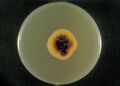 Trichophyton rubrum var. rodhaini
 -
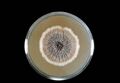 Sporothrix schenckii
 -
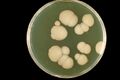 Candida albicans
 -
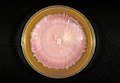 Trichophyton terrestre


Medical Disclaimer: WikiMD is for informational purposes only and is not a substitute for professional medical advice. Content may be inaccurate or outdated and should not be used for diagnosis or treatment. Always consult your healthcare provider for medical decisions. Verify information with trusted sources such as CDC.gov and NIH.gov. By using this site, you agree that WikiMD is not liable for any outcomes related to its content. See full disclaimer.
Credits:Most images are courtesy of Wikimedia commons, and templates, categories Wikipedia, licensed under CC BY SA or similar.
Translate page: - East Asian
中文,
日本,
한국어,
South Asian
हिन्दी,
தமிழ்,
తెలుగు,
Urdu,
ಕನ್ನಡ,
Southeast Asian
Indonesian,
Vietnamese,
Thai,
မြန်မာဘာသာ,
বাংলা
European
español,
Deutsch,
français,
Greek,
português do Brasil,
polski,
română,
русский,
Nederlands,
norsk,
svenska,
suomi,
Italian
Middle Eastern & African
عربى,
Turkish,
Persian,
Hebrew,
Afrikaans,
isiZulu,
Kiswahili,
Other
Bulgarian,
Hungarian,
Czech,
Swedish,
മലയാളം,
मराठी,
ਪੰਜਾਬੀ,
ગુજરાતી,
Portuguese,
Ukrainian

