Om Ali: Difference between revisions
CSV import |
CSV import |
||
| Line 19: | Line 19: | ||
[[Category:Middle Eastern cuisine]] | [[Category:Middle Eastern cuisine]] | ||
[[Category:Desserts]] | [[Category:Desserts]] | ||
<gallery> | |||
File:Rizbihaleeb.JPG|Rizbihaleeb | |||
File:Om_Ali_in_Khal_el_Khalili.jpg|Om Ali in Khal el Khalili | |||
</gallery> | |||
Latest revision as of 11:51, 25 February 2025

Om Ali (Arabic: أم علي), also known as Umm Ali or Oum Ali, is a traditional Egyptian dessert that has found its way into the hearts and kitchens of many across the Middle East and beyond. The name translates to "Ali's Mother," with various legends surrounding its origin, each attributing the creation of the dish to a woman closely related to someone named Ali. Despite the variations in its origin story, Om Ali is celebrated for its simplicity, rich flavor, and the communal joy it brings when shared.
Ingredients and Preparation[edit]
Om Ali is made from a combination of simple ingredients that come together to create a comforting and richly flavored dessert. The base of the dessert is made from pastry—traditionally, puff pastry, phyllo dough, or roqaq (a thin Egyptian pastry)—which is broken into pieces and layered in a baking dish. Mixed nuts such as almonds, pistachios, and hazelnuts, along with coconut flakes and raisins, are sprinkled over the pastry. The mixture is then soaked with hot milk sweetened with sugar and sometimes flavored with vanilla or cinnamon. The dish is baked until the top layer turns golden brown, resulting in a delightful contrast between the creamy, soft base and the crunchy topping.
Cultural Significance[edit]
Om Ali is not just a dessert; it's a dish steeped in history and cultural significance. It is often prepared during various Islamic holidays and family gatherings, serving as a symbol of unity and joy. The dessert's ease of preparation and the flexibility in the choice of ingredients make it a popular choice for festive occasions and a comforting treat during the colder months.
Variations[edit]
While the basic recipe for Om Ali is widely cherished, numerous variations exist, reflecting personal tastes and regional influences. Some versions use different types of bread or pastry, such as croissants or brioche, as the base. Others incorporate fresh fruit, such as apples or bananas, for added texture and flavor. The choice of nuts and dried fruits can also vary, allowing for a wide range of flavor combinations. In some modern interpretations, chocolate chips or a layer of custard is added to enrich the dessert further.
Serving[edit]
Om Ali is traditionally served warm, often with a dollop of fresh cream or a scoop of ice cream on the side. The warmth of the dessert, combined with the coolness of the cream or ice cream, creates a delightful sensory contrast. It is typically served in communal dishes, encouraging the sharing and social interaction that is at the heart of its cultural significance.
Conclusion[edit]
Om Ali stands as a testament to the rich culinary traditions of Egypt and the broader Middle East. Its simplicity, versatility, and the warmth it brings to gatherings make it a cherished dessert. Whether enjoyed in its most traditional form or through one of its many variations, Om Ali continues to be a symbol of hospitality, celebration, and the enduring power of shared meals to bring people together.
-
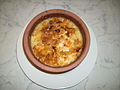 Rizbihaleeb
 -
 Om Ali in Khal el Khalili

