Toxic Substances Control Act of 1976: Difference between revisions
CSV import |
CSV import |
||
| (One intermediate revision by the same user not shown) | |||
| Line 1: | Line 1: | ||
{{Use American English|date=October 2023}} | |||
{{Use mdy dates|date=October 2023}} | |||
{{More citations needed|date=October 2023}} | |||
The '''Toxic Substances Control Act of 1976''' ( | The '''Toxic Substances Control Act of 1976''' (TSCA) is a United States law, administered by the [[United States Environmental Protection Agency|Environmental Protection Agency]] (EPA), that regulates the introduction of new or already existing [[chemical substances]]. It was enacted by the [[94th United States Congress]] and signed into law by [[President of the United States|President]] [[Gerald Ford]] on October 11, 1976. | ||
==Overview== | ==Overview== | ||
TSCA | The TSCA grants the EPA authority to require reporting, record-keeping, and testing requirements, and restrictions relating to chemical substances and/or mixtures. Certain substances are generally excluded from TSCA, including, among others, food, drugs, cosmetics, and pesticides. | ||
The TSCA addresses the production, importation, use, and disposal of specific chemicals including [[polychlorinated biphenyls]] (PCBs), [[asbestos]], [[radon]], and [[lead-based paint]]. | |||
==Key Provisions== | ==Key Provisions== | ||
===Existing Chemicals=== | |||
Under TSCA, the EPA is responsible for reviewing and regulating existing chemicals. The agency maintains the [[TSCA Chemical Substance Inventory]], which lists all existing chemical substances manufactured or processed in the United States. The EPA can require testing of chemicals to gather data on their effects on health and the environment. | |||
[[File:Existing_chemicals_review_-_TSCA_-_EPA.png|thumb|right|EPA's review process for existing chemicals under TSCA.]] | |||
== | ===New Chemicals=== | ||
The | Before a new chemical can be manufactured or imported, the manufacturer must submit a [[Pre-Manufacture Notice]] (PMN) to the EPA. The agency then assesses the potential risks associated with the chemical. If the EPA identifies potential risks, it can impose restrictions or require further testing. | ||
[[File:New_Chemicals_-_Active_Cases_Under_Review_-_EPA_11-01-2022.png|thumb|right|EPA's active cases under review for new chemicals.]] | |||
== | ===Polychlorinated Biphenyls (PCBs)=== | ||
PCBs are a group of man-made organic chemicals that were widely used in industrial and commercial applications. The TSCA banned the manufacture of PCBs in 1979 and regulates their disposal. | |||
[[File:PCB-labelling.jpg|thumb|right|Labeling of PCB-containing equipment.]] | |||
===Asbestos=== | |||
Asbestos is a naturally occurring mineral fiber that has been used in a variety of building construction materials for insulation and as a fire retardant. The TSCA regulates the use and disposal of asbestos to protect public health. | |||
[[File:Asbestos_abatement_(5392910701).jpg|thumb|right|Asbestos abatement in progress.]] | |||
===Lead=== | |||
Lead is a toxic metal that was once used in products found in and around homes, including paint. The TSCA includes provisions for the reduction of lead exposure, particularly in residential settings. | |||
[[File:When_buying_a_home,_ask_about_lead_-_EPA_2017.jpg|thumb|right|EPA's lead awareness campaign.]] | |||
==Amendments== | |||
The TSCA has been amended several times, most notably by the [[Frank R. Lautenberg Chemical Safety for the 21st Century Act]] in 2016, which significantly overhauled the law to improve the safety of chemicals in commerce. | |||
==Related pages== | |||
* [[Environmental Protection Agency]] | * [[Environmental Protection Agency]] | ||
* [[Chemical safety]] | * [[Chemical safety]] | ||
* [[Environmental law in the United States]] | |||
==References== | ==References== | ||
* "Toxic Substances Control Act (TSCA)." United States Environmental Protection Agency. [https://www.epa.gov/laws-regulations/summary-toxic-substances-control-act] | |||
* "Frank R. Lautenberg Chemical Safety for the 21st Century Act." United States Environmental Protection Agency. [https://www.epa.gov/assessing-and-managing-chemicals-under-tsca/frank-r-lautenberg-chemical-safety-21st-century-act] | |||
[[Category:United States federal environmental legislation]] | [[Category:United States federal environmental legislation]] | ||
[[Category:1976 in law]] | [[Category:1976 in American law]] | ||
[[Category: | [[Category:Chemical safety]] | ||
<gallery> | |||
File:PCB-labelling.jpg|PCB labelling | |||
File:When_buying_a_home,_ask_about_lead_-_EPA_2017.jpg|When buying a home, ask about lead - EPA 2017 | |||
File:Existing_chemicals_review_-_TSCA_-_EPA.png|Existing chemicals review - TSCA - EPA | |||
File:Asbestos_abatement_(5392910701).jpg|Asbestos abatement | |||
File:New_Chemicals_-_Active_Cases_Under_Review_-_EPA_11-01-2022.png|New Chemicals - Active Cases Under Review - EPA 11-01-2022 | |||
</gallery> | |||
Latest revision as of 04:28, 18 February 2025
 | This article needs additional citations for verification. (October 2023) |
The Toxic Substances Control Act of 1976 (TSCA) is a United States law, administered by the Environmental Protection Agency (EPA), that regulates the introduction of new or already existing chemical substances. It was enacted by the 94th United States Congress and signed into law by President Gerald Ford on October 11, 1976.
Overview[edit]
The TSCA grants the EPA authority to require reporting, record-keeping, and testing requirements, and restrictions relating to chemical substances and/or mixtures. Certain substances are generally excluded from TSCA, including, among others, food, drugs, cosmetics, and pesticides.
The TSCA addresses the production, importation, use, and disposal of specific chemicals including polychlorinated biphenyls (PCBs), asbestos, radon, and lead-based paint.
Key Provisions[edit]
Existing Chemicals[edit]
Under TSCA, the EPA is responsible for reviewing and regulating existing chemicals. The agency maintains the TSCA Chemical Substance Inventory, which lists all existing chemical substances manufactured or processed in the United States. The EPA can require testing of chemicals to gather data on their effects on health and the environment.

New Chemicals[edit]
Before a new chemical can be manufactured or imported, the manufacturer must submit a Pre-Manufacture Notice (PMN) to the EPA. The agency then assesses the potential risks associated with the chemical. If the EPA identifies potential risks, it can impose restrictions or require further testing.

Polychlorinated Biphenyls (PCBs)[edit]
PCBs are a group of man-made organic chemicals that were widely used in industrial and commercial applications. The TSCA banned the manufacture of PCBs in 1979 and regulates their disposal.

Asbestos[edit]
Asbestos is a naturally occurring mineral fiber that has been used in a variety of building construction materials for insulation and as a fire retardant. The TSCA regulates the use and disposal of asbestos to protect public health.
.jpg)
Lead[edit]
Lead is a toxic metal that was once used in products found in and around homes, including paint. The TSCA includes provisions for the reduction of lead exposure, particularly in residential settings.

Amendments[edit]
The TSCA has been amended several times, most notably by the Frank R. Lautenberg Chemical Safety for the 21st Century Act in 2016, which significantly overhauled the law to improve the safety of chemicals in commerce.
Related pages[edit]
References[edit]
- "Toxic Substances Control Act (TSCA)." United States Environmental Protection Agency. [1]
- "Frank R. Lautenberg Chemical Safety for the 21st Century Act." United States Environmental Protection Agency. [2]
-
 PCB labelling
 -
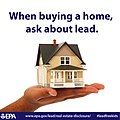 When buying a home, ask about lead - EPA 2017
 -
 Existing chemicals review - TSCA - EPA
 -
 Asbestos abatement
 -
 New Chemicals - Active Cases Under Review - EPA 11-01-2022
- Use American English from October 2023
- All Wikipedia articles written in American English
- Articles needing additional references from October 2023
- Articles with invalid date parameter in template
- All articles needing additional references
- United States federal environmental legislation
- 1976 in American law
- Chemical safety
