Garcinia pedunculata: Difference between revisions
CSV import Tags: mobile edit mobile web edit |
CSV import |
||
| (One intermediate revision by the same user not shown) | |||
| Line 23: | Line 23: | ||
{{fruit-stub}} | {{fruit-stub}} | ||
{{medicinal-plants-stub}} | {{medicinal-plants-stub}} | ||
<gallery> | |||
File:Garcinia_pedunculata.jpeg|Garcinia pedunculata | |||
File:Sukan_thekera.JPG|Sukan thekera | |||
</gallery> | |||
==Garcinia pedunculata== | |||
<gallery> | |||
File:Garcinia_pedunculata.jpeg|Garcinia pedunculata fruit | |||
File:Sukan_thekera.JPG|Sukan thekera | |||
</gallery> | |||
Latest revision as of 00:44, 18 February 2025
Garcinia mangostana, commonly known as the mangosteen, is a tropical evergreen tree believed to have originated in the Sunda Islands and the Moluccas of Indonesia. It grows mainly in Southeast Asia, southwest India and other tropical areas such as Puerto Rico and Florida, where the tree has been introduced. The tree grows from 7 to 25 m (20–80 ft) tall. The fruit of the mangosteen is sweet and tangy, juicy, and somewhat fibrous, with an inedible, deep reddish-purple colored rind (exocarp) when ripe.
Description[edit]
The Garcinia mangostana tree is very slow-growing, erect, with a pyramidal crown. It has dark-brown or nearly black, flaking bark, the inner bark producing a yellow, gummy and bitter latex. The leaves are evergreen, opposite, short-stalked, oval or elliptic and leathery. The flowers are dark red or sometimes yellowish, with 4 sepals and 4 petals.
Cultivation[edit]
The Garcinia mangostana tree requires tropical conditions and annual rainfall of at least 50 inches to grow. It is propagated by seeds and by air-layering, but is not adapted to grafting. The tree begins to bear fruit at 7-10 years old.
Uses[edit]
The fruit of the Garcinia mangostana is eaten fresh. It is also canned and used in jellies. The rind of the fruit has been used in traditional medicine as a treatment for diarrhea, skin infections and wounds.
Health Benefits[edit]
The fruit is rich in antioxidants and may have anti-inflammatory properties. Some studies suggest that it may also have potential benefits in treating a variety of health conditions, including cancer, heart disease, and diabetes.
See Also[edit]

This medicinal plants related article is a stub. You can help WikiMD by expanding it.
-
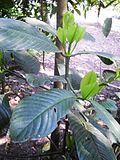 Garcinia pedunculata
 -
 Sukan thekera


Garcinia pedunculata[edit]
-
Garcinia pedunculata fruit
-
Sukan thekera
