Saag: Difference between revisions
CSV import Tags: mobile edit mobile web edit |
CSV import |
||
| Line 20: | Line 20: | ||
{{Indian-cuisine-stub}} | {{Indian-cuisine-stub}} | ||
{{Pakistani-cuisine-stub}} | {{Pakistani-cuisine-stub}} | ||
<gallery> | |||
File:Punjabi_Sarsoon_Ka_Saag.JPG|Punjabi Sarsoon Ka Saag | |||
File:Saag_Paneer.jpg|Saag Paneer | |||
File:Mutton_saag.jpg|Mutton Saag | |||
</gallery> | |||
Latest revision as of 21:43, 20 February 2025
Saag is a traditional Indian and Pakistani dish made from leafy green vegetables. It is a staple food in the Punjab region of both countries, and is also popular in other parts of the Indian subcontinent.
Ingredients and preparation[edit]
The main ingredient in saag is typically spinach, although it can also be made from other green vegetables such as mustard greens, collard greens, or broccoli. The vegetables are cooked until they are soft and then pureed to create a thick, creamy sauce.
Saag is often flavored with a variety of spices, including turmeric, cumin, coriander, and garam masala. It may also include onions, garlic, and ginger for additional flavor. Some versions of the dish also include paneer, a type of Indian cheese, or chicken or lamb for a non-vegetarian version.
Serving and consumption[edit]
Saag is typically served with roti or naan, types of Indian bread, or with rice. It can be eaten as a main course or as a side dish. In the Punjab region, it is often eaten with makki di roti, a type of bread made from cornmeal.
Cultural significance[edit]
Saag has a significant cultural importance in the Punjab region, where it is a traditional dish often served at celebrations and festivals. It is also a common dish in the Indian diaspora, where it is often used as a way to connect with cultural roots and traditions.
Health benefits[edit]
As a dish made primarily from leafy green vegetables, saag is high in vitamin A, vitamin C, and iron. It is also a good source of fiber, which can aid in digestion.

-
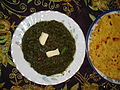 Punjabi Sarsoon Ka Saag
 -
 Saag Paneer
 -
 Mutton Saag


