List of meat substitutes: Difference between revisions
CSV import Tags: mobile edit mobile web edit |
CSV import |
||
| Line 41: | Line 41: | ||
[[Category:Sustainable food system]] | [[Category:Sustainable food system]] | ||
{{incomplete food list}} | {{incomplete food list}} | ||
== List of meat substitutes == | |||
<gallery> | |||
File:Soy_crush_steak.jpg|Soy crush steak | |||
File:Gunmakers,_Clerkenwell,_London_(6504848123).jpg|Gunmakers, Clerkenwell, London | |||
File:FryingBeanBurgers.JPG|Frying bean burgers | |||
File:Germanvegetariansausage.jpg|German vegetarian sausage | |||
File:Panir_Paneer_Indian_cheese_fresh.jpg|Panir Paneer Indian cheese fresh | |||
File:Jackfrucht_Fruchtfleisch_2.jpg|Jackfruit flesh | |||
File:Dong_Dou_Fu_(tofu).jpg|Dong Dou Fu (tofu) | |||
File:Sliced_tempeh_(cropped).jpg|Sliced tempeh | |||
</gallery> | |||
Latest revision as of 11:58, 25 February 2025
Meat substitutes, also known as meat analogues, meat alternatives or vegan meat, are products that mimic certain qualities of animal-based meat through flavor, texture, appearance, and nutritional content. These substitutes are usually created from plants, insects, fungi or mycoprotein.
Types of Meat Substitutes[edit]
Plant-Based Meat Substitutes[edit]
Plant-based meat substitutes are made from a variety of plants such as soy, wheat, and peas. Some popular plant-based meat substitutes include:
- Tofu: A food made from condensed soy milk that is pressed into solid white blocks. It is a traditional component of East Asian and Southeast Asian cuisines.
- Tempeh: A traditional Indonesian food made from fermented soybeans. It has a unique nutty flavor and firm texture.
- Seitan: Also known as wheat meat, it is made from gluten, the main protein of wheat.
- Textured Vegetable Protein (TVP): A versatile substance derived from soy flour to give it a texture similar to that of meat.
Insect-Based Meat Substitutes[edit]
Insect-based meat substitutes are made from edible insects. They are a good source of protein and are considered more environmentally friendly than traditional livestock. Examples include:
- Cricket Flour: A powder made from dried and ground crickets. It is often used in protein bars, pet foods, and other products.
- Mealworms: These are the larvae of darkling beetles and are often used in burgers and other foods as a meat substitute.
Fungi-Based Meat Substitutes[edit]
Fungi-based meat substitutes are made from edible fungi, such as mushrooms and mycoprotein. Examples include:
- Mycoprotein: A type of single-cell protein derived from fungi. It is used in the production of Quorn, a meat substitute.
- Mushrooms: Certain varieties of mushrooms, like portobello and shiitake, have a meaty texture and can be used as a meat substitute in various dishes.
Health and Environmental Impact[edit]
Meat substitutes are often lower in saturated fat and cholesterol than animal-based meat. They are also higher in fiber and can be a good source of protein. From an environmental perspective, meat substitutes are considered more sustainable than traditional livestock farming, as they require less land, water, and energy to produce.
See Also[edit]
This is a non-exhaustive food and drink related list.

List of meat substitutes[edit]
-
 Soy crush steak
 -
 Gunmakers, Clerkenwell, London
 -
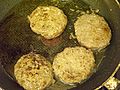 Frying bean burgers
 -
 German vegetarian sausage
 -
 Panir Paneer Indian cheese fresh
 -
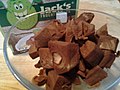 Jackfruit flesh
 -
Dong Dou Fu (tofu)
-
Sliced tempeh

.jpg)


.jpg)
.jpg)