Plum cake: Difference between revisions
CSV import Tags: mobile edit mobile web edit |
CSV import |
||
| (2 intermediate revisions by the same user not shown) | |||
| Line 1: | Line 1: | ||
{{Short description|A type of cake made with dried fruits and spices}} | |||
{{Use dmy dates|date=October 2023}} | |||
'''Plum cake''' is a type of cake made with dried fruits and spices, and often soaked in spirits. It is a traditional cake in many countries and is especially popular during the Christmas season. Despite its name, plum cake does not necessarily contain plums; the term "plum" in the name refers to the pre-Victorian use of the word to denote raisins or other dried fruits. | |||
The | ==History== | ||
The origins of plum cake can be traced back to the early [[Middle Ages]] when dried fruits and spices were first introduced to [[Europe]] from the [[Middle East]]. These ingredients were expensive and considered a luxury, often reserved for special occasions. Over time, the recipe evolved, and by the 18th century, plum cake had become a popular dessert in [[England]]. | |||
== | ==Ingredients== | ||
Plum cake recipes vary widely, but they typically include a mixture of dried fruits such as [[raisins]], [[currants]], [[sultanas]], and [[prunes]]. The cake is often flavored with spices like [[cinnamon]], [[nutmeg]], and [[cloves]]. Many recipes also call for the fruits to be soaked in [[brandy]] or [[rum]] for several days before baking, which enhances the flavor and preserves the cake. | |||
===Common Ingredients=== | |||
* Dried fruits (raisins, currants, sultanas, prunes) | |||
* Spices (cinnamon, nutmeg, cloves) | |||
* Alcohol (brandy, rum) | |||
* [[Butter]] | |||
* [[Sugar]] | |||
* [[Flour]] | |||
* [[Eggs]] | |||
* [[Baking powder]] | |||
== | ==Preparation== | ||
The preparation of plum cake involves several steps. First, the dried fruits are soaked in alcohol for a few days to enhance their flavor. The butter and sugar are creamed together until light and fluffy, and then eggs are added one at a time. The flour and baking powder are sifted together and folded into the mixture. Finally, the soaked fruits and spices are added, and the batter is poured into a prepared cake tin. | |||
The | The cake is typically baked at a low temperature for a long period to ensure even cooking. Once baked, it is often wrapped in parchment paper and stored in an airtight container to mature for several weeks, allowing the flavors to develop further. | ||
== | ==Variations== | ||
Plum cake has many regional variations. In [[Germany]], it is known as ''Pflaumenkuchen'' and is made with fresh plums. In [[India]], plum cake is a popular Christmas treat, often made with cashews and almonds in addition to dried fruits. In the [[Caribbean]], black cake is a type of plum cake that is darkened with burnt sugar and heavily spiced. | |||
==Cultural Significance== | |||
Plum cake is traditionally associated with [[Christmas]] and is often served during the holiday season. In many cultures, it is customary to bake the cake weeks in advance and allow it to mature, enhancing its rich flavors. It is also a popular choice for weddings and other celebrations. | |||
==Related pages== | |||
* [[Fruitcake]] | |||
* [[Christmas cake]] | |||
* [[Black cake]] | |||
* [[Baking]] | |||
[[Category:Cakes]] | [[Category:Cakes]] | ||
[[Category:Christmas food]] | [[Category:Christmas food]] | ||
[[Category: | [[Category:Fruit dishes]] | ||
<gallery> | |||
File:Plum_cake_08_ies.jpg|Plum cake 08 ies | |||
File:Baskidische_Pflaumenkuchen..JPG|Baskidische Pflaumenkuchen | |||
File:Worlds_Best_Fruitcake_Katya_Creates_photo_D_Ramey_Logan.jpg|World's Best Fruitcake Katya Creates photo D Ramey Logan | |||
File:Pâté_aux_prunes.jpg|Pâté aux prunes | |||
File:00349_Pflaumenkuchen,_Sanok_2011.jpg|Pflaumenkuchen Sanok 2011 | |||
File:2015_0804_Zwetschkenkuchen_Gaislachalm_Sölden.jpg|Zwetschkenkuchen Gaislachalm Sölden | |||
File:Plun_pie_-_Luumupiirakka_IMG_3757_C.JPG|Plun pie Luumupiirakka IMG 3757 C | |||
File:Plum_cake_04_ies.jpg|Plum cake 04 ies | |||
</gallery> | |||
Latest revision as of 12:01, 25 February 2025
A type of cake made with dried fruits and spices
Plum cake is a type of cake made with dried fruits and spices, and often soaked in spirits. It is a traditional cake in many countries and is especially popular during the Christmas season. Despite its name, plum cake does not necessarily contain plums; the term "plum" in the name refers to the pre-Victorian use of the word to denote raisins or other dried fruits.
History[edit]
The origins of plum cake can be traced back to the early Middle Ages when dried fruits and spices were first introduced to Europe from the Middle East. These ingredients were expensive and considered a luxury, often reserved for special occasions. Over time, the recipe evolved, and by the 18th century, plum cake had become a popular dessert in England.
Ingredients[edit]
Plum cake recipes vary widely, but they typically include a mixture of dried fruits such as raisins, currants, sultanas, and prunes. The cake is often flavored with spices like cinnamon, nutmeg, and cloves. Many recipes also call for the fruits to be soaked in brandy or rum for several days before baking, which enhances the flavor and preserves the cake.
Common Ingredients[edit]
- Dried fruits (raisins, currants, sultanas, prunes)
- Spices (cinnamon, nutmeg, cloves)
- Alcohol (brandy, rum)
- Butter
- Sugar
- Flour
- Eggs
- Baking powder
Preparation[edit]
The preparation of plum cake involves several steps. First, the dried fruits are soaked in alcohol for a few days to enhance their flavor. The butter and sugar are creamed together until light and fluffy, and then eggs are added one at a time. The flour and baking powder are sifted together and folded into the mixture. Finally, the soaked fruits and spices are added, and the batter is poured into a prepared cake tin.
The cake is typically baked at a low temperature for a long period to ensure even cooking. Once baked, it is often wrapped in parchment paper and stored in an airtight container to mature for several weeks, allowing the flavors to develop further.
Variations[edit]
Plum cake has many regional variations. In Germany, it is known as Pflaumenkuchen and is made with fresh plums. In India, plum cake is a popular Christmas treat, often made with cashews and almonds in addition to dried fruits. In the Caribbean, black cake is a type of plum cake that is darkened with burnt sugar and heavily spiced.
Cultural Significance[edit]
Plum cake is traditionally associated with Christmas and is often served during the holiday season. In many cultures, it is customary to bake the cake weeks in advance and allow it to mature, enhancing its rich flavors. It is also a popular choice for weddings and other celebrations.
Related pages[edit]
-
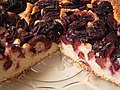 Plum cake 08 ies
 -
 Baskidische Pflaumenkuchen
 -
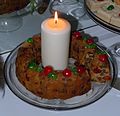 World's Best Fruitcake Katya Creates photo D Ramey Logan
 -
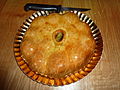 Pâté aux prunes
 -
 Pflaumenkuchen Sanok 2011
 -
 Zwetschkenkuchen Gaislachalm Sölden
 -
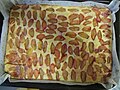 Plun pie Luumupiirakka IMG 3757 C
 -
Plum cake 04 ies


