Furazolidone: Difference between revisions
Created page with "thumb|right|Chemical structure of Furazolidone '''Furazolidone''' is a synthetic nitrofuran compound with antimicrobial properties. It has been use..." |
CSV import |
||
| (One intermediate revision by the same user not shown) | |||
| Line 1: | Line 1: | ||
{{Short description|An article about the use of Furazolidone in medicine}} | |||
{{Drugbox | |||
| verifiedrevid = 477241123 | |||
| image = Furazolidone.svg | |||
| image2 = | |||
| width = 200px | |||
| alt = | |||
| caption = Chemical structure of Furazolidone | |||
}} | |||
'''Furazolidone''' is | '''Furazolidone''' is an [[antimicrobial]] agent that has been used in the treatment of bacterial and protozoal infections. It belongs to the class of [[nitrofuran]] antibiotics and has been used in both human and veterinary medicine. | ||
== | ==Mechanism of Action== | ||
Furazolidone | Furazolidone works by interfering with the [[DNA]] of bacteria and protozoa, inhibiting their ability to reproduce and repair themselves. This action is primarily bacteriostatic, meaning it stops bacteria from multiplying, but it can also be bactericidal at higher concentrations. | ||
==Medical Uses== | |||
Furazolidone has been used to treat a variety of infections, including: | |||
* [[Giardiasis]] | |||
* [[Cholera]] | |||
* [[Bacterial diarrhea]] | |||
* [[Helicobacter pylori]] infections | |||
== | It is particularly effective against infections caused by [[Gram-negative bacteria]] and some protozoa. | ||
==Side Effects== | |||
Common side effects of furazolidone include: | |||
* Nausea | * Nausea | ||
* Vomiting | * Vomiting | ||
| Line 22: | Line 32: | ||
* Abdominal pain | * Abdominal pain | ||
It is | Rare but serious side effects can include: | ||
* [[Allergic reactions]] | |||
* [[Peripheral neuropathy]] | |||
* [[Hepatotoxicity]] | |||
==Contraindications== | |||
Furazolidone should not be used in individuals with known hypersensitivity to nitrofuran derivatives. It is also contraindicated in patients with [[glucose-6-phosphate dehydrogenase deficiency]] due to the risk of hemolytic anemia. | |||
==Drug Interactions== | |||
Furazolidone can interact with other medications, including: | |||
* [[Monoamine oxidase inhibitors]] (MAOIs) | |||
* [[Antidepressants]] | |||
* [[Sympathomimetic drugs]] | |||
These interactions can lead to increased blood pressure and other cardiovascular effects. | |||
==Regulatory Status== | |||
Furazolidone has been withdrawn from the market in many countries due to concerns about its safety profile and the availability of safer alternatives. However, it may still be used in some regions under specific circumstances. | |||
== | ==Also see== | ||
* [[Nitrofuran]] | |||
* [[Antimicrobial resistance]] | |||
* [[Antibiotic]] | |||
* [[Giardiasis]] | |||
== References == | ==References== | ||
{{Reflist}} | {{Reflist}} | ||
[[Category: | [[Category:Antimicrobial agents]] | ||
[[Category: | [[Category:Nitrofuran antibiotics]] | ||
[[Category: | [[Category:Withdrawn drugs]] | ||
<gallery> | |||
File:Furazolidone.svg|Furazolidone | |||
File:Furazolidone 3D spacefill.png|Furazolidone 3D Spacefill | |||
</gallery> | |||
Latest revision as of 01:38, 20 February 2025
An article about the use of Furazolidone in medicine
Furazolidone is an antimicrobial agent that has been used in the treatment of bacterial and protozoal infections. It belongs to the class of nitrofuran antibiotics and has been used in both human and veterinary medicine.
Mechanism of Action[edit]
Furazolidone works by interfering with the DNA of bacteria and protozoa, inhibiting their ability to reproduce and repair themselves. This action is primarily bacteriostatic, meaning it stops bacteria from multiplying, but it can also be bactericidal at higher concentrations.
Medical Uses[edit]
Furazolidone has been used to treat a variety of infections, including:
- Giardiasis
- Cholera
- Bacterial diarrhea
- Helicobacter pylori infections
It is particularly effective against infections caused by Gram-negative bacteria and some protozoa.
Side Effects[edit]
Common side effects of furazolidone include:
- Nausea
- Vomiting
- Diarrhea
- Abdominal pain
Rare but serious side effects can include:
Contraindications[edit]
Furazolidone should not be used in individuals with known hypersensitivity to nitrofuran derivatives. It is also contraindicated in patients with glucose-6-phosphate dehydrogenase deficiency due to the risk of hemolytic anemia.
Drug Interactions[edit]
Furazolidone can interact with other medications, including:
These interactions can lead to increased blood pressure and other cardiovascular effects.
Regulatory Status[edit]
Furazolidone has been withdrawn from the market in many countries due to concerns about its safety profile and the availability of safer alternatives. However, it may still be used in some regions under specific circumstances.
Also see[edit]
References[edit]
<references group="" responsive="1"></references>
-
 Furazolidone
 -
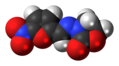 Furazolidone 3D Spacefill


