Mesopotamia: Difference between revisions
CSV import Tags: mobile edit mobile web edit |
CSV import |
||
| Line 29: | Line 29: | ||
{{stub}} | {{stub}} | ||
{{dictionary-stub1}} | {{dictionary-stub1}} | ||
<gallery> | |||
File:N-Mesopotamia_and_Syria_english.svg|Mesopotamia and Syria map | |||
File:Mesopotamia_9_October_2020.jpg|Mesopotamia landscape | |||
File:Mosul_river.jpg|Mosul river | |||
File:اهوار_العراق_ليلا.jpg|Iraqi marshes at night | |||
File:Statue_Gudea_Met_59.2.jpg|Statue of Gudea | |||
File:Jarmo_to_Ubaid_7000-4500.jpg|Jarmo to Ubaid period | |||
File:Ancient_Egypt_and_Mesopotamia_c._1450_BC.png|Ancient Egypt and Mesopotamia c. 1450 BC | |||
File:P1050763_Louvre_code_Hammurabi_face_rwk.JPG|Code of Hammurabi | |||
File:Tablet_XI_or_the_Flood_Tablet_of_the_Epic_of_Gilgamesh,_currently_housed_in_the_British_Museum_in_London.jpg|Flood Tablet of the Epic of Gilgamesh | |||
File:Clay_tablet,_mathematical,_geometric-algebraic,_similar_to_the_Euclidean_geometry._From_Tell_Harmal,_Iraq._2003-1595_BCE._Iraq_Museum.jpg|Mathematical clay tablet | |||
File:Medical_recipe_concerning_poisoning._Terracotta_tablet,_from_Nippur,_Iraq,_18th_century_BCE._Ancient_Orient_Museum,_Istanbul.jpg|Medical recipe tablet | |||
File:Lilith_Periodo_de_Isin_Larsa_y_Babilonia.JPG|Lilith from Isin-Larsa and Babylon period | |||
</gallery> | |||
Latest revision as of 21:35, 23 February 2025
Mesopotamia is a historical region located in the eastern Mediterranean. It is bounded to the northeast by the Zagros Mountains, to the west by the Syrian Desert, and to the south by the Arabian Desert. The name "Mesopotamia" comes from the ancient Greek words "mesos" (middle) and "potamos" (river), meaning "land between the rivers". The region is known for its rich history and cultural heritage, being home to some of the earliest known civilizations.
Geography[edit]
Mesopotamia encompasses the land between the Euphrates and Tigris rivers, both of which have their headwaters in the Taurus Mountains of eastern Turkey. The region is generally flat, making it ideal for agriculture. It is often referred to as the Fertile Crescent due to its fertile soil and crescent shape.
History[edit]
Mesopotamia has a long and complex history. It was home to many ancient civilizations, including the Sumerians, Akkadians, Babylonians, and Assyrians. These civilizations made significant contributions to human culture, including the invention of writing, the development of complex social structures, and advances in art, science, and technology.
Culture[edit]
The cultures of Mesopotamia were diverse and sophisticated. They developed complex social structures, with a ruling class of kings and priests, a middle class of merchants and artisans, and a lower class of farmers and slaves. They also developed a complex system of writing, known as cuneiform, which was used for record keeping, legal documents, literature, and religious texts.
Religion[edit]
Religion played a central role in Mesopotamian society. The people believed in a pantheon of gods and goddesses, who were thought to control all aspects of the natural world. The most important deities were Anu, the sky god; Enlil, the god of wind and storm; and Enki, the god of water and wisdom.
See also[edit]
References[edit]
<references />
 | |
|---|---|
 |
 |
-
 Mesopotamia and Syria map
 -
 Mesopotamia landscape
 -
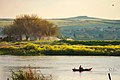 Mosul river
 -
 Iraqi marshes at night
 -
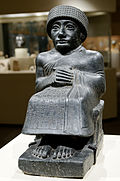 Statue of Gudea
 -
 Jarmo to Ubaid period
 -
 Ancient Egypt and Mesopotamia c. 1450 BC
 -
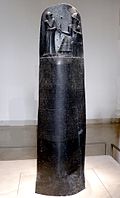 Code of Hammurabi
 -
 Flood Tablet of the Epic of Gilgamesh
 -
 Mathematical clay tablet
 -
 Medical recipe tablet
 -
 Lilith from Isin-Larsa and Babylon period


