Sahara: Difference between revisions
CSV import |
CSV import |
||
| Line 31: | Line 31: | ||
{{stub}} | {{stub}} | ||
== Sahara == | |||
<gallery> | |||
File:Sahara.svg|Sahara | |||
File:Vegetation_Africa.png|Vegetation Africa | |||
File:Sahara_satellite_hires.jpg|Sahara satellite hires | |||
File:Hoggar8.jpg|Hoggar | |||
File:Algeria_Sahara_Desert_Photo_From_Drone_5.jpg|Algeria Sahara Desert Photo From Drone | |||
File:Sunset_in_Sahara.jpg|Sunset in Sahara | |||
File:Journal.pone.0076514.g004.png|Journal pone 0076514 g004 | |||
File:Village_Telly_in_Mali.jpg|Village Telly in Mali | |||
File:Great_green_wall_map.svg|Great green wall map | |||
File:Saharan_topographic_elements_map.png|Saharan topographic elements map | |||
File:GueltaCamels.jpg|Guelta Camels | |||
File:Libya_5391_Ubari_Lakes_Luca_Galuzzi_2007.jpg|Libya 5391 Ubari Lakes Luca Galuzzi 2007 | |||
</gallery> | |||
Latest revision as of 21:14, 23 February 2025
Sahara
The Sahara is the largest hot desert and the third largest desert overall after Antarctica and the Arctic. Its area of 9,200,000 square kilometers is comparable to the area of China or the United States. The desert comprises much of North Africa, excluding the fertile region on the Mediterranean Sea coast, the Atlas Mountains of the Maghreb, and the Nile Valley in Egypt and Sudan. It stretches from the Red Sea in the east and the Mediterranean in the north to the Atlantic Ocean in the west, where the landscape gradually changes from desert to coastal plains. To the south, it is bounded by the Sahel, a belt of semi-arid tropical savanna around the Niger River valley and the Sudan Region of Sub-Saharan Africa.
Geography[edit]
The Sahara can be divided into several regions including: the western Sahara, the central Ahaggar Mountains, the Tibesti Mountains, the Aïr Mountains, the Ténéré desert, and the Libyan Desert. The highest peak in the Sahara is Emi Koussi, a shield volcano in the Tibesti range of northern Chad.
Climate[edit]
The Sahara's climate consists of basically two sub-climates, a dry subtropical climate in the north and a dry tropical climate in the south. The southern part of the Sahara is characterized by high temperatures that can exceed 50 °C (122 °F) while the northern part, due to its higher altitude, is a bit cooler.
Flora and Fauna[edit]
Despite the harsh conditions, several life forms have adapted to the extreme conditions of the Sahara. Some of the plant species in the Sahara include the Acacia tree, the date palm, and several species of cactus. Animal life includes the dromedary camel, the fennec fox, and the monitor lizard.
Human History[edit]
The Sahara has been inhabited by various human groups since prehistoric times. Occupying the Sahara has presented significant challenges to those living in its fringes since the climate is extremely dry and the vegetation sparse. Several cultures have developed and fallen in the Sahara.
See Also[edit]
 | |
|---|---|
 |
 |
Sahara[edit]
-
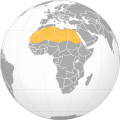 Sahara
 -
 Vegetation Africa
 -
 Sahara satellite hires
 -
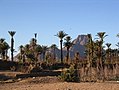 Hoggar
 -
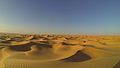 Algeria Sahara Desert Photo From Drone
 -
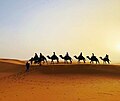 Sunset in Sahara
 -
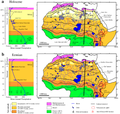 Journal pone 0076514 g004
 -
 Village Telly in Mali
 -
 Great green wall map
 -
 Saharan topographic elements map
 -
 Guelta Camels
 -
 Libya 5391 Ubari Lakes Luca Galuzzi 2007


