Pastirma: Difference between revisions
CSV import |
CSV import |
||
| Line 25: | Line 25: | ||
[[Category:Mediterranean cuisine]] | [[Category:Mediterranean cuisine]] | ||
{{food-stub}} | {{food-stub}} | ||
== Pastirma == | |||
<gallery> | |||
File:Basturma or Pastroma from Armenia 2.JPG|Pastirma | |||
File:Pastirma with three eggs.jpg|Pastirma with three eggs | |||
</gallery> | |||
Latest revision as of 00:47, 20 February 2025
Pastirma is a highly seasoned, air-dried cured beef product that is a part of various cuisines across the Mediterranean, Middle East, and Central Asia. The name 'pastirma' is derived from the Turkish word 'bastırma', which means 'pressed'.
History[edit]
The origins of pastirma are believed to date back to the Byzantine Empire, where it was known as 'paston'. The Turks further developed the method of making pastirma during the Ottoman Empire. It was a popular food among the nomadic tribes due to its long shelf life and high nutritional value.
Preparation[edit]
The preparation of pastirma involves salting the meat, then washing it in water and letting it dry for 10-15 days. The meat is then covered with a paste known as 'çemen', made from crushed garlic, fenugreek, and paprika, and left to cure for another 10-15 days. The çemen not only adds flavor but also helps to preserve the meat.
Consumption[edit]
Pastirma is often sliced thinly and served as part of a mezze platter or used in cooking. It can be used in a variety of dishes, including pasta, pizza, and sandwiches. In Turkish cuisine, it is commonly used in a dish called 'pastirma with eggs'.
Variations[edit]
There are several variations of pastirma, depending on the region. In Greece, it is known as 'pastourmas' and is typically made with beef or camel meat. In Armenia, 'basturma' is a similar product made with beef or lamb.
See also[edit]

Pastirma[edit]
-
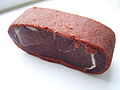 Pastirma
 -
 Pastirma with three eggs


