Genetic assimilation: Difference between revisions
CSV import Tags: mobile edit mobile web edit |
CSV import |
||
| Line 23: | Line 23: | ||
[[Category:Genetics]] | [[Category:Genetics]] | ||
{{biology-stub}} | {{biology-stub}} | ||
<gallery> | |||
File:Drosophile_normale_et_cross-veinless.jpg|Drosophila with normal and cross-veinless wings | |||
File:Lamarck_Compared_to_Darwin,_Baldwin,_Waddington.svg|Comparison of Lamarck, Darwin, Baldwin, and Waddington's theories | |||
File:Chappell_Island_tiger_snake.jpg|Chappell Island tiger snake | |||
</gallery> | |||
Latest revision as of 04:16, 18 February 2025
Genetic Assimilation is a concept in evolutionary biology that explains how a phenotype originally produced in response to an environmental condition can become genetically encoded via natural selection. This process allows for phenotypic changes that are initially independent of genetic variation to become genetically stabilized and inheritable without the direct modification of the organism's DNA sequence. The term was first introduced by the British geneticist C.H. Waddington in the mid-20th century to describe the outcomes of his experiments on the development of the fruit fly, Drosophila melanogaster.
Overview[edit]
Genetic assimilation challenges the traditional neo-Darwinian view by suggesting that the environment can indirectly guide evolution by selecting for organisms that have a predisposed capacity to develop certain traits under specific conditions. Waddington's work involved exposing fruit flies to ether, which induced a phenotypic change (the development of a bithorax phenotype). Through selective breeding of these ether-induced flies, he was able to produce a strain that exhibited the bithorax phenotype without ether treatment, indicating that the trait had become genetically assimilated.
Mechanism[edit]
The mechanism behind genetic assimilation involves the concept of genetic canalization, where developmental pathways are stabilized and made more robust to environmental and genetic perturbations. This canalization process can hide genetic variation (cryptic genetic variation) from selection until it is "revealed" by environmental stresses. Once revealed, this variation can be acted upon by natural selection, leading to the genetic assimilation of the phenotype.
Implications[edit]
The concept of genetic assimilation has significant implications for our understanding of evolution, developmental biology, and the interplay between genes and the environment. It suggests that organisms can adapt to new environments through a combination of genetic changes and phenotypic plasticity, with the latter potentially guiding the direction of evolutionary change.
Controversy and Current Views[edit]
While genetic assimilation is widely recognized, its frequency and importance in nature have been subjects of debate. Critics argue that the process may not be as common or as significant as Waddington suggested. However, recent studies in epigenetics and the discovery of more examples of phenotypic plasticity leading to genetic changes have revived interest in genetic assimilation as a potential evolutionary mechanism.
See Also[edit]
- Evolutionary developmental biology
- Phenotypic plasticity
- Epigenetics
- Natural selection
- C.H. Waddington

-
 Drosophila with normal and cross-veinless wings
 -
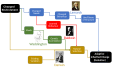 Comparison of Lamarck, Darwin, Baldwin, and Waddington's theories
 -
 Chappell Island tiger snake


