U-47700: Difference between revisions
CSV import |
CSV import |
||
| (One intermediate revision by the same user not shown) | |||
| Line 1: | Line 1: | ||
{{Short description|Synthetic opioid analgesic}} | |||
{{Drugbox | |||
| verifiedfields = changed | |||
| verifiedrevid = 477002 | |||
| image = U-47700_fixedstructure.svg | |||
| image2 = U-47700.png | |||
| image3 = Sample_of_U-47700.png | |||
| IUPAC_name = (3,4-dichlorophenyl)-[1-(dimethylamino)-2-methylpropyl]methanone | |||
| CAS_number = 82657-23-6 | |||
}} | |||
'''U-47700''' is a synthetic [[opioid]] analgesic drug developed by [[Upjohn]] in the 1970s. It is structurally related to other opioids such as [[AH-7921]] and is known for its potent analgesic effects. U-47700 has gained notoriety as a [[designer drug]] and has been associated with numerous cases of overdose and fatalities. | |||
U-47700 | ==Chemical structure and properties== | ||
U-47700 is a member of the [[benzamide]] class of opioids. Its chemical structure is characterized by a 3,4-dichlorophenyl group attached to a methanone moiety, with a dimethylamino group at the 1-position and a methyl group at the 2-position of the propyl chain. This structure contributes to its high affinity for the [[mu-opioid receptor]], which is responsible for its analgesic and euphoric effects. | |||
== Pharmacology == | ==Pharmacology== | ||
U-47700 acts primarily as a [[mu-opioid receptor]] agonist, similar to other opioids such as [[morphine]] and [[fentanyl]]. It produces effects such as pain relief, sedation, and euphoria. However, it also carries a high risk of respiratory depression, which can be fatal in overdose situations. The potency of U-47700 is estimated to be several times that of morphine. | |||
U-47700 | ==Legal status== | ||
Due to its potential for abuse and associated health risks, U-47700 has been classified as a controlled substance in many countries. In the [[United States]], it was temporarily placed in [[Schedule I]] of the [[Controlled Substances Act]] in 2016, indicating that it has a high potential for abuse and no accepted medical use. | |||
== | ==Health risks and safety== | ||
The use of U-47700 has been linked to numerous adverse effects, including [[respiratory depression]], [[cardiac arrest]], and death. It is often found in combination with other substances, which can increase the risk of overdose. Users may also experience withdrawal symptoms similar to those of other opioids. | |||
==Related pages== | |||
* [[Opioid]] | |||
* [[Designer drug]] | |||
* [[Controlled Substances Act]] | |||
== | ==References== | ||
{{Reflist}} | |||
[[Category:Synthetic opioids]] | |||
[[Category: | |||
[[Category:Designer drugs]] | [[Category:Designer drugs]] | ||
[[Category: | [[Category:Controlled substances]] | ||
<gallery> | |||
File:U-47700_fixedstructure.svg|Chemical structure of U-47700 | |||
File:U-47700.png|U-47700 | |||
File:Sample_of_U-47700.png|Sample of U-47700 | |||
</gallery> | |||
Latest revision as of 01:41, 18 February 2025
Synthetic opioid analgesic
| U-47700 | |
|---|---|

| |
| INN | |
| Drug class | |
| Routes of administration | |
| Pregnancy category | |
| Bioavailability | |
| Metabolism | |
| Elimination half-life | |
| Excretion | |
| Legal status | |
| CAS Number | 82657-23-6 |
| PubChem | |
| DrugBank | |
| ChemSpider | |
| KEGG | |
U-47700 is a synthetic opioid analgesic drug developed by Upjohn in the 1970s. It is structurally related to other opioids such as AH-7921 and is known for its potent analgesic effects. U-47700 has gained notoriety as a designer drug and has been associated with numerous cases of overdose and fatalities.
Chemical structure and properties[edit]
U-47700 is a member of the benzamide class of opioids. Its chemical structure is characterized by a 3,4-dichlorophenyl group attached to a methanone moiety, with a dimethylamino group at the 1-position and a methyl group at the 2-position of the propyl chain. This structure contributes to its high affinity for the mu-opioid receptor, which is responsible for its analgesic and euphoric effects.
Pharmacology[edit]
U-47700 acts primarily as a mu-opioid receptor agonist, similar to other opioids such as morphine and fentanyl. It produces effects such as pain relief, sedation, and euphoria. However, it also carries a high risk of respiratory depression, which can be fatal in overdose situations. The potency of U-47700 is estimated to be several times that of morphine.
Legal status[edit]
Due to its potential for abuse and associated health risks, U-47700 has been classified as a controlled substance in many countries. In the United States, it was temporarily placed in Schedule I of the Controlled Substances Act in 2016, indicating that it has a high potential for abuse and no accepted medical use.
Health risks and safety[edit]
The use of U-47700 has been linked to numerous adverse effects, including respiratory depression, cardiac arrest, and death. It is often found in combination with other substances, which can increase the risk of overdose. Users may also experience withdrawal symptoms similar to those of other opioids.
Related pages[edit]
References[edit]
<references group="" responsive="1"></references>
-
 Chemical structure of U-47700
 -
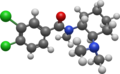 U-47700
 -
 Sample of U-47700


