Gajak: Difference between revisions
CSV import |
CSV import |
||
| Line 27: | Line 27: | ||
{{Indian-cuisine-stub}} | {{Indian-cuisine-stub}} | ||
{{food-stub}} | {{food-stub}} | ||
<gallery> | |||
File:Gachak.JPG|Gajak | |||
File:Gur_Rewari_(a_kind_of_Gajak)_from_Lucknow,_a_traditional_Indian_snack_made_with_Jaggery_and_crunchy_sesame_seeds_in_the_form_of_crispy_bars.jpg|Gur Rewari, a kind of Gajak from Lucknow, a traditional Indian snack made with jaggery and crunchy sesame seeds in the form of crispy bars | |||
</gallery> | |||
Latest revision as of 01:28, 18 February 2025
Gajak is a traditional Indian sweet that is primarily made from sesame seeds and jaggery. It is a popular dessert, especially during the winter season and is often associated with festivals such as Makar Sankranti and Lohri.
History[edit]
The origin of Gajak dates back to ancient times in India. It is believed to have been a part of the Indian diet since the Indus Valley Civilization. The use of sesame seeds and jaggery, the primary ingredients of Gajak, can be traced back to these ancient times.
Preparation[edit]
The preparation of Gajak involves roasting sesame seeds until they turn golden brown. The jaggery is then melted and mixed with the roasted sesame seeds. This mixture is then spread on a flat surface and allowed to cool. Once cooled, it is cut into pieces and served.
Variations[edit]
There are several variations of Gajak, each differing based on the ingredients used and the method of preparation. Some of the popular variations include:
- Til Gajak: This is the most common form of Gajak, made with sesame seeds and jaggery.
- Mungfali Gajak: This variation is made with peanuts instead of sesame seeds.
- Dry Fruit Gajak: This is a richer version of Gajak, made with a variety of dry fruits and nuts.
Cultural Significance[edit]
Gajak holds a significant place in Indian culture. It is traditionally consumed during the winter season, as both sesame seeds and jaggery are known to have heat-generating properties. It is also associated with various Indian festivals. During Makar Sankranti, it is customary to distribute Gajak among friends and family. Similarly, during Lohri, Gajak is often thrown into the bonfire as an offering.
See Also[edit]


-
 Gajak
Gajak -
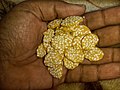 Gur Rewari, a kind of Gajak from Lucknow, a traditional Indian snack made with jaggery and crunchy sesame seeds in the form of crispy bars

_from_Lucknow,_a_traditional_Indian_snack_made_with_Jaggery_and_crunchy_sesame_seeds_in_the_form_of_crispy_bars.jpg)
