Gajak
Gajak is a traditional Indian sweet that is primarily made from sesame seeds and jaggery. It is a popular dessert, especially during the winter season and is often associated with festivals such as Makar Sankranti and Lohri.
History[edit]
The origin of Gajak dates back to ancient times in India. It is believed to have been a part of the Indian diet since the Indus Valley Civilization. The use of sesame seeds and jaggery, the primary ingredients of Gajak, can be traced back to these ancient times.
Preparation[edit]
The preparation of Gajak involves roasting sesame seeds until they turn golden brown. The jaggery is then melted and mixed with the roasted sesame seeds. This mixture is then spread on a flat surface and allowed to cool. Once cooled, it is cut into pieces and served.
Variations[edit]
There are several variations of Gajak, each differing based on the ingredients used and the method of preparation. Some of the popular variations include:
- Til Gajak: This is the most common form of Gajak, made with sesame seeds and jaggery.
- Mungfali Gajak: This variation is made with peanuts instead of sesame seeds.
- Dry Fruit Gajak: This is a richer version of Gajak, made with a variety of dry fruits and nuts.
Cultural Significance[edit]
Gajak holds a significant place in Indian culture. It is traditionally consumed during the winter season, as both sesame seeds and jaggery are known to have heat-generating properties. It is also associated with various Indian festivals. During Makar Sankranti, it is customary to distribute Gajak among friends and family. Similarly, during Lohri, Gajak is often thrown into the bonfire as an offering.
See Also[edit]


-
Gajak
-
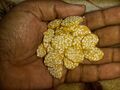 Gur Rewari, a kind of Gajak from Lucknow, a traditional Indian snack made with jaggery and crunchy sesame seeds in the form of crispy bars
_from_Lucknow,_a_traditional_Indian_snack_made_with_Jaggery_and_crunchy_sesame_seeds_in_the_form_of_crispy_bars.jpg)

Medical Disclaimer: WikiMD is for informational purposes only and is not a substitute for professional medical advice. Content may be inaccurate or outdated and should not be used for diagnosis or treatment. Always consult your healthcare provider for medical decisions. Verify information with trusted sources such as CDC.gov and NIH.gov. By using this site, you agree that WikiMD is not liable for any outcomes related to its content. See full disclaimer.
Credits:Most images are courtesy of Wikimedia commons, and templates, categories Wikipedia, licensed under CC BY SA or similar.
Translate page: - East Asian
中文,
日本,
한국어,
South Asian
हिन्दी,
தமிழ்,
తెలుగు,
Urdu,
ಕನ್ನಡ,
Southeast Asian
Indonesian,
Vietnamese,
Thai,
မြန်မာဘာသာ,
বাংলা
European
español,
Deutsch,
français,
Greek,
português do Brasil,
polski,
română,
русский,
Nederlands,
norsk,
svenska,
suomi,
Italian
Middle Eastern & African
عربى,
Turkish,
Persian,
Hebrew,
Afrikaans,
isiZulu,
Kiswahili,
Other
Bulgarian,
Hungarian,
Czech,
Swedish,
മലയാളം,
मराठी,
ਪੰਜਾਬੀ,
ગુજરાતી,
Portuguese,
Ukrainian


