Young's modulus
Young's modulus (also known as the elastic modulus, the tensile modulus, or modulus of elasticity) is a measure of the stiffness of a solid material. It defines the relationship between stress (force per unit area) and strain (proportional deformation) in a material. Young's modulus is named after the 19th-century British scientist Thomas Young.
Etymology[edit]
The term "Young's modulus" is named after the British scientist Thomas Young, who first introduced the concept in the 19th century. The term "modulus" comes from the Latin word for "measure", while "elastic" refers to the property of a material to return to its original shape after being deformed.
Definition[edit]
Young's modulus, E, can be defined as the ratio of tensile stress (σ) to tensile strain (ε) within the elastic deformation phase of a material:
E = σ / ε
This equation implies that the stress and strain in a material are linearly related, which is a characteristic of elastic materials.
Units[edit]
In the International System of Units (SI), Young's modulus is measured in pascals (Pa). The unit is named after the French mathematician and physicist Blaise Pascal.
Related Terms[edit]
- Stress: Force per unit area within materials that arises from externally applied forces, uneven heating, or permanent deformation.
- Strain: Deformation of materials in response to stress.
- Elasticity: The ability of a body to resist a distorting influence and to return to its original size and shape when that influence or force is removed.
- Pascal: The SI unit of pressure, defined as one newton per square meter.
See Also[edit]
References[edit]

This WikiMD article can only be edited by registered and verified editors. You can log in or register.
-
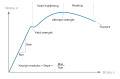 Stress-strain curve for a ductile material
 -
 Spider graph showing Young's modulus
 -
 Illustration from "De Abditis Morborum Causis"


Medical Disclaimer: WikiMD is for informational purposes only and is not a substitute for professional medical advice. Content may be inaccurate or outdated and should not be used for diagnosis or treatment. Always consult your healthcare provider for medical decisions. Verify information with trusted sources such as CDC.gov and NIH.gov. By using this site, you agree that WikiMD is not liable for any outcomes related to its content. See full disclaimer.
Credits:Most images are courtesy of Wikimedia commons, and templates, categories Wikipedia, licensed under CC BY SA or similar.
Translate page: - East Asian
中文,
日本,
한국어,
South Asian
हिन्दी,
தமிழ்,
తెలుగు,
Urdu,
ಕನ್ನಡ,
Southeast Asian
Indonesian,
Vietnamese,
Thai,
မြန်မာဘာသာ,
বাংলা
European
español,
Deutsch,
français,
Greek,
português do Brasil,
polski,
română,
русский,
Nederlands,
norsk,
svenska,
suomi,
Italian
Middle Eastern & African
عربى,
Turkish,
Persian,
Hebrew,
Afrikaans,
isiZulu,
Kiswahili,
Other
Bulgarian,
Hungarian,
Czech,
Swedish,
മലയാളം,
मराठी,
ਪੰਜਾਬੀ,
ગુજરાતી,
Portuguese,
Ukrainian

