Vitreous membrane
The Vitreous Membrane also known as hyaloid membrane or vitreous cortex is a thin, transparent layer that encloses the vitreous body in the eye. It is a part of the visual system and plays a crucial role in maintaining the shape and structure of the eye.
Etymology[edit]
The term "vitreous" is derived from the Latin word "vitreus", which means "glassy". This is in reference to the glass-like, transparent nature of the vitreous body. The term "hyaloid" is derived from the Greek words "hyalos", meaning "glass", and "eidos", meaning "form" or "shape". This term is used to describe the membrane's glass-like appearance and its role in maintaining the shape of the vitreous body.
Structure[edit]
The vitreous membrane is a thin, transparent layer that surrounds the vitreous body. It is composed of collagen and hyaluronic acid, which give it its elasticity and transparency. The membrane is firmly attached to the retina at the optic disc, the macula, and the ora serrata. It is also loosely attached to the rest of the retina.
Function[edit]
The primary function of the vitreous membrane is to enclose and protect the vitreous body. It also helps to maintain the shape of the eye by providing a barrier against the movement of fluid and cells. This is important for maintaining the clarity of the visual axis and preventing the development of floaters.
Clinical significance[edit]
Damage or detachment of the vitreous membrane can lead to a number of eye conditions, including vitreous detachment, vitreous hemorrhage, and retinal detachment. These conditions can cause symptoms such as floaters, flashes of light, and loss of vision, and may require medical intervention.
See also[edit]
References[edit]

This WikiMD article can only be edited by registered and verified editors. You can log in or register.
-
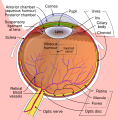 Schematic diagram of the human eye
 -
 Vitreous membrane


Medical Disclaimer: WikiMD is for informational purposes only and is not a substitute for professional medical advice. Content may be inaccurate or outdated and should not be used for diagnosis or treatment. Always consult your healthcare provider for medical decisions. Verify information with trusted sources such as CDC.gov and NIH.gov. By using this site, you agree that WikiMD is not liable for any outcomes related to its content. See full disclaimer.
Credits:Most images are courtesy of Wikimedia commons, and templates, categories Wikipedia, licensed under CC BY SA or similar.
Translate page: - East Asian
中文,
日本,
한국어,
South Asian
हिन्दी,
தமிழ்,
తెలుగు,
Urdu,
ಕನ್ನಡ,
Southeast Asian
Indonesian,
Vietnamese,
Thai,
မြန်မာဘာသာ,
বাংলা
European
español,
Deutsch,
français,
Greek,
português do Brasil,
polski,
română,
русский,
Nederlands,
norsk,
svenska,
suomi,
Italian
Middle Eastern & African
عربى,
Turkish,
Persian,
Hebrew,
Afrikaans,
isiZulu,
Kiswahili,
Other
Bulgarian,
Hungarian,
Czech,
Swedish,
മലയാളം,
मराठी,
ਪੰਜਾਬੀ,
ગુજરાતી,
Portuguese,
Ukrainian

