Tweezers
A tool used for picking up small objects


Tweezers are small tools used for picking up objects too small to be easily handled with the human fingers. They are used in a variety of applications, including cosmetics, electronics, and medicine.
History[edit]
The use of tweezers dates back to ancient times. Archaeological evidence suggests that tweezers were used in Ancient Egypt, Mesopotamia, and India. Bronze tweezers have been found in Mesopotamian sites, such as the Royal Cemetery of Ur, dating back to 2550-2450 BCE.
Design and Materials[edit]
Tweezers are typically made from metal, but they can also be made from other materials such as plastic or ceramic. The most common metals used are stainless steel, bronze, and gold. Stainless steel tweezers are popular due to their resistance to corrosion and durability.
Types of Tweezers[edit]
There are several types of tweezers, each designed for specific tasks:
- Flat-tip tweezers: Used for general purposes.
- Pointed-tip tweezers: Ideal for precision work, such as in electronics or medical applications.
- Slant-tip tweezers: Commonly used in cosmetics for plucking hair.
- Round-tip tweezers: Used for handling delicate items without causing damage.
- Cross-lock tweezers: These tweezers remain closed until pressure is applied, useful for holding objects without constant pressure.
Applications[edit]
Tweezers are used in a variety of fields:
- In cosmetics, they are used for eyebrow plucking and applying false eyelashes.
- In electronics, they are used for handling small components and wires.
- In medicine, tweezers are used in surgery and first aid to remove foreign objects from the body.
Gallery[edit]
-
A pair of tweezers
-
Modern round-tipped tweezers
-
Cross tweezers, straight and bent
-
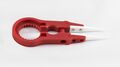 Ceramic tweezers
 -
Functional ceramic tweezers

Related pages[edit]

Medical Disclaimer: WikiMD is for informational purposes only and is not a substitute for professional medical advice. Content may be inaccurate or outdated and should not be used for diagnosis or treatment. Always consult your healthcare provider for medical decisions. Verify information with trusted sources such as CDC.gov and NIH.gov. By using this site, you agree that WikiMD is not liable for any outcomes related to its content. See full disclaimer.
Credits:Most images are courtesy of Wikimedia commons, and templates, categories Wikipedia, licensed under CC BY SA or similar.
Translate page: - East Asian
中文,
日本,
한국어,
South Asian
हिन्दी,
தமிழ்,
తెలుగు,
Urdu,
ಕನ್ನಡ,
Southeast Asian
Indonesian,
Vietnamese,
Thai,
မြန်မာဘာသာ,
বাংলা
European
español,
Deutsch,
français,
Greek,
português do Brasil,
polski,
română,
русский,
Nederlands,
norsk,
svenska,
suomi,
Italian
Middle Eastern & African
عربى,
Turkish,
Persian,
Hebrew,
Afrikaans,
isiZulu,
Kiswahili,
Other
Bulgarian,
Hungarian,
Czech,
Swedish,
മലയാളം,
मराठी,
ਪੰਜਾਬੀ,
ગુજરાતી,
Portuguese,
Ukrainian


