The Canon of Medicine
The Canon of Medicine (Al-Qanun fi al-Tibb) is a seminal scholarly work by Persian polymath Avicenna (Ibn Sina, 980–1037 AD). It is a comprehensive medical encyclopedia that compiled the totality of medical knowledge available from ancient and Muslim sources at the time. The Canon of Medicine was written in Arabic and later translated into Latin, Persian, and other languages, marking a significant influence on the development of medicine in both the Islamic world and Europe for several centuries.
Overview[edit]
The Canon of Medicine is organized into five books covering various aspects of medicine and health. The first book deals with general medical principles, the second with simple drugs and materia medica, the third with diseases affecting specific parts of the body, the fourth with diseases that are not specific to certain organs (such as fevers), and the fifth with compound medicines.
Influence and Legacy[edit]
The work's influence extended beyond the Islamic world into Europe, where it became a standard medical text at many medieval universities, often in its Latin translation, Canon Medicinae. The Canon of Medicine remained a medical authority until the 17th century and has been regarded as one of the most famous books in the history of medicine.
Contents[edit]
The Canon of Medicine provides a clear and systematic approach to the practice of medicine and was notable for its introduction of systematic experimentation and quantification into the study of physiology, along with a rational approach to discovering the causes of diseases and the preparation of medicines. It covers topics such as anatomy, pathology, diagnostics, infectious diseases, and pharmacology.
Book I: General Principles[edit]
Book I discusses the general principles of medicine, including the theory of the four humors, the nature of the human body, and the interaction between the body and the environment.
Book II: Materia Medica[edit]
Book II is dedicated to simple drugs and substances used in the treatment of illnesses, detailing their nature, effects, and medicinal uses.
Book III: Pathology[edit]
Book III focuses on diseases that affect specific parts of the body, providing descriptions, symptoms, and treatments for each.
Book IV: Diseases Not Specific to Certain Organs[edit]
Book IV covers diseases that do not specifically affect one part of the body, such as fevers and other systemic conditions.
Book V: Compound Medicines[edit]
Book V describes compound medicines and prescriptions, including their preparation, properties, and uses.
Methodology[edit]
Avicenna's approach in The Canon of Medicine was revolutionary for its emphasis on experimentation and evidence-based medicine. He advocated for the testing of medicines, detailed descriptions of diseases and their observations, and the importance of diet and lifestyle for health.
Translations and Impact[edit]
The Canon of Medicine was translated into Latin in the 12th century and became a cornerstone of medical education in Europe. Its influence was profound, shaping medical theory and practice for centuries.
Conclusion[edit]
The Canon of Medicine is a landmark in the history of medicine, reflecting the culmination of medical knowledge up to its time and significantly influencing the development of medicine in both the Islamic world and the West. Its systematic approach and emphasis on empirical evidence and rationality laid the groundwork for modern medical science.
 | This medical article is a stub. You can help WikiMD by expanding the page. |
-
 The Canon of Medicine
 -
 Avicenna's Canon, 1597 edition
 -
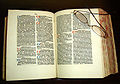 The Canon of Medicine


Medical Disclaimer: WikiMD is for informational purposes only and is not a substitute for professional medical advice. Content may be inaccurate or outdated and should not be used for diagnosis or treatment. Always consult your healthcare provider for medical decisions. Verify information with trusted sources such as CDC.gov and NIH.gov. By using this site, you agree that WikiMD is not liable for any outcomes related to its content. See full disclaimer.
Credits:Most images are courtesy of Wikimedia commons, and templates, categories Wikipedia, licensed under CC BY SA or similar.
Translate page: - East Asian
中文,
日本,
한국어,
South Asian
हिन्दी,
தமிழ்,
తెలుగు,
Urdu,
ಕನ್ನಡ,
Southeast Asian
Indonesian,
Vietnamese,
Thai,
မြန်မာဘာသာ,
বাংলা
European
español,
Deutsch,
français,
Greek,
português do Brasil,
polski,
română,
русский,
Nederlands,
norsk,
svenska,
suomi,
Italian
Middle Eastern & African
عربى,
Turkish,
Persian,
Hebrew,
Afrikaans,
isiZulu,
Kiswahili,
Other
Bulgarian,
Hungarian,
Czech,
Swedish,
മലയാളം,
मराठी,
ਪੰਜਾਬੀ,
ગુજરાતી,
Portuguese,
Ukrainian

