Tetrapyrrole
Tetrapyrroles are a class of organic compounds that play a crucial role in various biological processes. These molecules are characterized by a structure consisting of four pyrrole rings interconnected through methine bridges (-CH=). This structure forms a macrocyclic compound, which can bind metals at its core, leading to the formation of several important biological pigments, including chlorophylls, hemes, and cytochromes.
Structure and Properties[edit]
Tetrapyrroles are heterocyclic organic compounds that contain four pyrrole subunits. These subunits are connected via methine bridges, creating a large, cyclic structure. The nature of the metal ion bound in the center of the tetrapyrrole ring system can significantly alter the compound's properties and functions. For example, when iron is bound within the tetrapyrrole ring, the resulting compound is a heme, which is essential for oxygen transport and cellular respiration in many organisms.
Biosynthesis[edit]
The biosynthesis of tetrapyrroles is a complex process that involves several enzymatic steps. It begins with the condensation of the amino acid glycine and succinyl-CoA to form aminolevulinic acid (ALA), a precursor to all tetrapyrroles. This process, known as the ALA synthesis pathway, involves multiple enzymes and regulatory mechanisms to ensure the proper production and assembly of tetrapyrrole molecules. The biosynthesis pathways can vary among different organisms and for different types of tetrapyrroles.
Functions[edit]
Tetrapyrroles perform a wide range of biological functions, owing to their ability to chelate metal ions and participate in electron transfer reactions. Some of the key roles include:
- Oxygen Transport and Storage: Heme, a type of tetrapyrrole, is a component of hemoglobin and myoglobin, which are responsible for oxygen transport and storage in animals.
- Photosynthesis: Chlorophyll, another tetrapyrrole, is essential for the absorption of light energy and its conversion into chemical energy during photosynthesis in plants and algae.
- Electron Transport: Cytochromes, which contain heme groups, are involved in the electron transport chain, a critical component of cellular respiration in both plants and animals.
Clinical Significance[edit]
Tetrapyrroles are also of clinical significance. Disorders in the biosynthesis of heme, for example, lead to a group of diseases known as porphyrias, which can affect the nervous system and the skin. Additionally, the study of tetrapyrroles and their synthetic analogs has implications in the development of photodynamic therapy for treating cancer.
See Also[edit]
References[edit]
.svg) | This biochemistry article is a stub. You can help WikiMD by expanding the page. |
-
 Bilirubin structure
 -
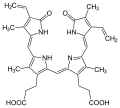 Biliverdin structure
 -
Phycoerythrobilin structure
-
 Luciferin structure in dinoflagellates
 -
 Uroporphyrinogen III skeletal structure
 -
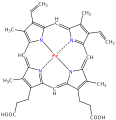 Heme structure
 -
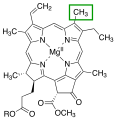 Chlorophyll a structure at C-3 position
 -
 Cobalamin structure


Sponsored Health Resource

W8MD Weight Loss, Sleep & MedSpa
Looking for physician-supervised weight loss, semaglutide, tirzepatide, or GLP-1 receptor agonist options? W8MD helps eligible patients in New York City, Brooklyn, New Jersey, Connecticut, Pennsylvania, Delaware, and greater Philadelphia with medical weight loss, sleep medicine, and long-term maintenance support.
GLP-1 specials: Affordable GLP-1 injections NYC and Philadelphia starting from $29.99/week and up for semaglutide with insurance accepted for qualifying visits, and $45/week and up for tirzepatide with insurance accepted for qualifying visits. Self-pay options start from $59.99/week and up for semaglutide and $69.99/week and up for tirzepatide.
Medical weight loss NYC | Affordable GLP-1 injections NYC | Budget GLP-1 weight loss shots Philadelphia | New Jersey medical weight loss | NYC medical weight loss | Philadelphia medical weight loss | Sleep clinic NYC | W8MD's Philadelphia GLP-1 doctor | Weight loss prescriptions NYC
Book a W8MD appointment · View GLP-1 specials
Paid promotional message. Eligibility, pricing, insurance coverage, medication availability, and results vary. Medical evaluation required.

Medical Disclaimer: WikiMD is for informational purposes only and is not a substitute for professional medical advice. Content may be inaccurate or outdated and should not be used for diagnosis or treatment. Always consult your healthcare provider for medical decisions. Verify information with trusted sources such as CDC.gov and NIH.gov. By using this site, you agree that WikiMD is not liable for any outcomes related to its content. See full disclaimer.
Credits:Most images are courtesy of Wikimedia commons, and templates, categories Wikipedia, licensed under CC BY SA or similar.
Translate page: - East Asian
中文,
日本,
한국어,
South Asian
हिन्दी,
தமிழ்,
తెలుగు,
Urdu,
ಕನ್ನಡ,
Southeast Asian
Indonesian,
Vietnamese,
Thai,
မြန်မာဘာသာ,
বাংলা
European
español,
Deutsch,
français,
Greek,
português do Brasil,
polski,
română,
русский,
Nederlands,
norsk,
svenska,
suomi,
Italian
Middle Eastern & African
عربى,
Turkish,
Persian,
Hebrew,
Afrikaans,
isiZulu,
Kiswahili,
Other
Bulgarian,
Hungarian,
Czech,
Swedish,
മലയാളം,
मराठी,
ਪੰਜਾਬੀ,
ગુજરાતી,
Portuguese,
Ukrainian


