Mountaineering
Mountaineering or mountain climbing is the sport, hobby or profession of hiking, skiing, and climbing mountains. While mountaineering began as attempts to reach the highest point of unclimbed big mountains, it has branched into specializations that address different aspects of the mountain and consists of three areas: rock-craft, snow-craft and skiing, depending on whether the route chosen is over rock, snow or ice. All require experience, athletic ability, and technical knowledge to maintain safety.
History[edit]
Mountaineering has a rich and complex history that spans centuries. The sport has evolved from early ascents for geographical exploration purposes to a popular recreational activity. The first recorded mountaineering ascent is often considered to be Antoine de Ville's climb of Mont Aiguille in 1492.
Equipment[edit]
Mountaineering equipment has evolved greatly over the years. From simple tools like ropes and ice axes, the gear used in mountaineering has become more sophisticated and specialized. Today, mountaineers use a variety of equipment including helmets, harnesses, carabiners, belay devices, and crampons.
Techniques[edit]
There are several techniques that mountaineers use to climb mountains. These include but are not limited to: rock climbing, ice climbing, mixed climbing, and alpine climbing. Each technique requires a different set of skills and equipment.
Risks[edit]
Mountaineering is a dangerous sport that can result in serious injury or death. Risks include falling, avalanches, hypothermia, and high altitude sickness. Despite these risks, many people are drawn to mountaineering for the physical challenge and the thrill of conquering a mountain.
See also[edit]

This WikiMD article can only be edited by registered and verified editors. You can log in or register.
-
 M Rainier
 -
 Edward Whymper Calkin
 -
 Leontopodium alpinum
 -
 William Cecil Slingsby Storen
 -
 Owen Glynne Jones
 -
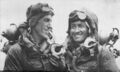 Edmund Hillary and Tenzing Norgay
 -
 Climbing tools - Mount Shasta Sisson Museum
 -
 Ortler Ascent - South Tyrol
 -
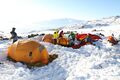 Ararat Camp 1
 -
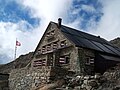 Cabane du Trient
 -
 Climber Summit Manaslu 8163m
 -
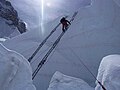 Inside Khumbu Icefall


.jpg)


Medical Disclaimer: WikiMD is for informational purposes only and is not a substitute for professional medical advice. Content may be inaccurate or outdated and should not be used for diagnosis or treatment. Always consult your healthcare provider for medical decisions. Verify information with trusted sources such as CDC.gov and NIH.gov. By using this site, you agree that WikiMD is not liable for any outcomes related to its content. See full disclaimer.
Credits:Most images are courtesy of Wikimedia commons, and templates, categories Wikipedia, licensed under CC BY SA or similar.
Translate page: - East Asian
中文,
日本,
한국어,
South Asian
हिन्दी,
தமிழ்,
తెలుగు,
Urdu,
ಕನ್ನಡ,
Southeast Asian
Indonesian,
Vietnamese,
Thai,
မြန်မာဘာသာ,
বাংলা
European
español,
Deutsch,
français,
Greek,
português do Brasil,
polski,
română,
русский,
Nederlands,
norsk,
svenska,
suomi,
Italian
Middle Eastern & African
عربى,
Turkish,
Persian,
Hebrew,
Afrikaans,
isiZulu,
Kiswahili,
Other
Bulgarian,
Hungarian,
Czech,
Swedish,
മലയാളം,
मराठी,
ਪੰਜਾਬੀ,
ગુજરાતી,
Portuguese,
Ukrainian

