Statistical dispersion
Statistical dispersion refers to a set of values or elements that measure the spread or variability in a data set. It is a key concept in statistics and is used to understand the degree of diversity or dissimilarity in the data. Statistical dispersion can be measured using several methods, including the range, variance, standard deviation, and interquartile range.
Definition[edit]
Statistical dispersion is defined as the extent to which a distribution is stretched or squeezed. It is a measure of the variability or spread in a set of data. The concept is widely used in fields such as mathematics, statistics, economics, sociology, and psychology.
Measures of Statistical Dispersion[edit]
There are several measures of statistical dispersion, each with its own strengths and weaknesses. These include:
- Range: The difference between the highest and lowest values in a data set.
- Variance: The average of the squared differences from the mean.
- Standard deviation: The square root of the variance, providing a measure of dispersion that is in the same units as the data.
- Interquartile range: The range within which the central 50% of the values fall.
Applications[edit]
Statistical dispersion is used in a variety of fields to understand the variability of data. In economics, it can be used to understand income inequality. In psychology, it can be used to understand the variability in responses to a survey. In medicine, it can be used to understand the spread of a disease in a population.
See Also[edit]
References[edit]
 | This statistics-related article is a stub. You can help WikiMD by expanding the page. |
Statistical dispersion[edit]
-
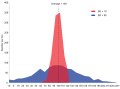 Comparison of standard deviations


Medical Disclaimer: WikiMD is for informational purposes only and is not a substitute for professional medical advice. Content may be inaccurate or outdated and should not be used for diagnosis or treatment. Always consult your healthcare provider for medical decisions. Verify information with trusted sources such as CDC.gov and NIH.gov. By using this site, you agree that WikiMD is not liable for any outcomes related to its content. See full disclaimer.
Credits:Most images are courtesy of Wikimedia commons, and templates, categories Wikipedia, licensed under CC BY SA or similar.
Translate page: - East Asian
中文,
日本,
한국어,
South Asian
हिन्दी,
தமிழ்,
తెలుగు,
Urdu,
ಕನ್ನಡ,
Southeast Asian
Indonesian,
Vietnamese,
Thai,
မြန်မာဘာသာ,
বাংলা
European
español,
Deutsch,
français,
Greek,
português do Brasil,
polski,
română,
русский,
Nederlands,
norsk,
svenska,
suomi,
Italian
Middle Eastern & African
عربى,
Turkish,
Persian,
Hebrew,
Afrikaans,
isiZulu,
Kiswahili,
Other
Bulgarian,
Hungarian,
Czech,
Swedish,
മലയാളം,
मराठी,
ਪੰਜਾਬੀ,
ગુજરાતી,
Portuguese,
Ukrainian

