Social network

A social network is a social structure made up of a set of social actors (such as individuals or organizations), sets of dyadic ties, and other social interactions between actors. The social network perspective provides a set of methods for analyzing the structure of whole social entities as well as a variety of theories explaining the patterns observed in these structures. The study of these structures uses social network analysis to identify local and global patterns, locate influential entities, and examine network dynamics.
Social networks operate on many levels, from families up to the level of nations, and play a critical role in determining the way problems are solved, organizations are run, and the degree to which individuals succeed in achieving their goals. An underlying assumption of the social network approach is that social phenomena should be primarily conceived and investigated through the properties of relations between and within units, instead of the properties of these units themselves.
Types of Social Networks[edit]
Social networks can manifest in a variety of forms, including:
- Online social networks: Platforms like Facebook, Twitter, LinkedIn, and Instagram that allow users to connect and interact over the internet. - Professional networks: Networks that focus on professional connections and career development, often found within specific industries or professions. - Community networks: These networks are based on shared interests, geographical locations, or cultural ties. - Academic networks: Networks within the academic community that facilitate collaboration, information sharing, and mentorship among students, teachers, and researchers.
Importance of Social Networks[edit]
Social networks have a significant impact on various aspects of life, including:
- Social capital: The benefits individuals gain from their relationships with others, including support, information, and resources. - Information diffusion: The spread of information through networks, which can influence opinions, behaviors, and innovation adoption. - Influence and power dynamics: The structure of social networks can affect the distribution of power and influence among actors.
Challenges and Criticisms[edit]
While social networks have many benefits, they also pose several challenges:
- Privacy concerns: Especially relevant for online social networks where personal information can be exposed or misused. - Social isolation: Paradoxically, despite being more connected, individuals may experience loneliness and isolation due to superficial online interactions. - Echo chambers: The phenomenon where networks reinforce existing beliefs and viewpoints, limiting exposure to diverse perspectives.
Future Directions[edit]
The future of social networks may involve more sophisticated technologies, such as artificial intelligence and machine learning, to enhance connectivity and provide more personalized experiences. Additionally, there is a growing interest in understanding the impact of social networks on mental health and developing strategies to mitigate negative effects.
 | This medical article is a stub. You can help WikiMD by expanding the page. |
-
 Barabási–Albert model
 -
 Moreno Sociogram 2nd Grade
 -
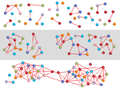 Network self-organization stages
 -
 Social Network Diagram
 -
 Social Red
 -
 Scale-free network sample
 -
 Diagram of a social network


.svg)


Medical Disclaimer: WikiMD is for informational purposes only and is not a substitute for professional medical advice. Content may be inaccurate or outdated and should not be used for diagnosis or treatment. Always consult your healthcare provider for medical decisions. Verify information with trusted sources such as CDC.gov and NIH.gov. By using this site, you agree that WikiMD is not liable for any outcomes related to its content. See full disclaimer.
Credits:Most images are courtesy of Wikimedia commons, and templates, categories Wikipedia, licensed under CC BY SA or similar.
Translate this page: - East Asian
中文,
日本,
한국어,
South Asian
हिन्दी,
தமிழ்,
తెలుగు,
Urdu,
ಕನ್ನಡ,
Southeast Asian
Indonesian,
Vietnamese,
Thai,
မြန်မာဘာသာ,
বাংলা
European
español,
Deutsch,
français,
Greek,
português do Brasil,
polski,
română,
русский,
Nederlands,
norsk,
svenska,
suomi,
Italian
Middle Eastern & African
عربى,
Turkish,
Persian,
Hebrew,
Afrikaans,
isiZulu,
Kiswahili,
Other
Bulgarian,
Hungarian,
Czech,
Swedish,
മലയാളം,
मराठी,
ਪੰਜਾਬੀ,
ગુજરાતી,
Portuguese,
Ukrainian
