Single-nucleotide polymorphism
Single-nucleotide polymorphism (SNP; pronounced "snip") is a variation in a single nucleotide that occurs at a specific position in the genome. SNPs are the most common type of genetic variation among people. Each SNP represents a difference in a single DNA building block, called a nucleotide. For example, a SNP may replace the nucleotide cytosine (C) with the nucleotide thymine (T) in a certain stretch of DNA. SNPs can occur within coding regions of genes, non-coding regions of genes, or in the intergenic regions between genes. Depending on where they occur, SNPs can have a wide range of effects on gene function and health.
Types of SNPs[edit]
There are several types of SNPs, including:
- Synonymous SNPs: These do not change the protein sequence that the gene produces.
- Non-synonymous SNPs: These change the amino acid sequence of a protein and can affect the protein's function.
- Insertion/deletion SNPs: These involve the insertion or deletion of nucleotides in the genome.
- Regulatory SNPs: These occur in gene regulatory regions and can affect gene expression.
Importance of SNPs[edit]
SNPs are important for several reasons:
- Genetic Diversity: They contribute to the genetic diversity among individuals, which can influence a wide range of physical traits and susceptibility to diseases.
- Disease Research: SNPs are used in genetic association studies to identify genes that may contribute to common diseases.
- Pharmacogenomics: SNPs can influence how individuals respond to drugs, which is the basis of pharmacogenomics.
- Forensic Science: SNPs can be used in forensic testing to help identify individuals.
Detecting SNPs[edit]
SNPs can be detected using various molecular biology techniques, including:
Applications of SNP Information[edit]
The information gained from studying SNPs has a wide range of applications, including:
- Understanding the genetic basis of diseases
- Developing new drugs and treatments
- Personalized medicine, where treatments are tailored to an individual's genetic makeup
- Improving crop varieties in agriculture
Challenges and Considerations[edit]
While SNPs offer great potential for advancing medical and biological research, there are challenges and considerations, including:
- The need for large-scale studies to accurately identify SNP-disease associations
- Ethical considerations in genetic testing and privacy
- The potential for genetic discrimination based on SNP information
See Also[edit]

-
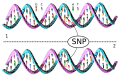 Single-nucleotide polymorphism
 -
 Types of SNP
 -
 Associations between SNPs, methylation patterns, and gene expression


Advertise on WikiMD — 81,000+ full articles, ~900,000 total pages, ~250 million page views. Global reach, limited time promotional rates from $1/page/day. Learn more · View stats

Medical Disclaimer: WikiMD is for informational purposes only and is not a substitute for professional medical advice. Content may be inaccurate or outdated and should not be used for diagnosis or treatment. Always consult your healthcare provider for medical decisions. Verify information with trusted sources such as CDC.gov and NIH.gov. By using this site, you agree that WikiMD is not liable for any outcomes related to its content. See full disclaimer.
Credits:Most images are courtesy of Wikimedia commons, and templates, categories Wikipedia, licensed under CC BY SA or similar.
Translate page: - East Asian
中文,
日本,
한국어,
South Asian
हिन्दी,
தமிழ்,
తెలుగు,
Urdu,
ಕನ್ನಡ,
Southeast Asian
Indonesian,
Vietnamese,
Thai,
မြန်မာဘာသာ,
বাংলা
European
español,
Deutsch,
français,
Greek,
português do Brasil,
polski,
română,
русский,
Nederlands,
norsk,
svenska,
suomi,
Italian
Middle Eastern & African
عربى,
Turkish,
Persian,
Hebrew,
Afrikaans,
isiZulu,
Kiswahili,
Other
Bulgarian,
Hungarian,
Czech,
Swedish,
മലയാളം,
मराठी,
ਪੰਜਾਬੀ,
ગુજરાતી,
Portuguese,
Ukrainian

