Signs and symptoms of Graves' disease
X-ray machine is a device used in medicine to generate X-ray images of the human body. This is achieved by passing a controlled amount of X-ray radiation through the body and capturing the radiation that is transmitted onto a detector or film. The resulting image can be used to diagnose and monitor a variety of medical conditions.
History[edit]
The X-ray machine was invented by Wilhelm Conrad Roentgen in 1895. Roentgen discovered that a cathode ray tube produced a new kind of ray when it struck a fluorescent screen. He named these rays X-rays, the 'X' standing for 'unknown'. Roentgen's discovery revolutionized the field of medicine, as it allowed doctors to see inside the human body without surgery.
How X-ray machines work[edit]
An X-ray machine consists of two main components: the X-ray tube and the X-ray detector. The X-ray tube generates X-rays, while the detector captures the X-rays that pass through the body.
The X-ray tube contains a cathode and an anode. When the machine is turned on, the cathode heats up and releases electrons. These electrons are accelerated towards the anode, where they collide with the anode material and produce X-rays.
The X-ray detector captures the X-rays that pass through the body. The detector can be a film that darkens when exposed to X-rays, or a digital detector that converts the X-rays into an electronic signal.
Uses in medicine[edit]
X-ray machines are used in a variety of medical applications. They are most commonly used to image the bones, but can also be used to image the chest, abdomen, and other parts of the body. X-ray machines can help diagnose fractures, infections, tumors, and other medical conditions.
In addition to diagnostic imaging, X-ray machines are also used in therapeutic applications. For example, they can be used to treat cancer through radiation therapy.
Safety and risks[edit]
While X-ray machines are a valuable tool in medicine, they also pose some risks. X-rays are a form of ionizing radiation, which can damage cells and cause cancer. However, the risk is generally low and is often outweighed by the benefits of accurate diagnosis and treatment.
Patients are protected from unnecessary radiation exposure by using the lowest possible X-ray dose, using lead shields to protect sensitive parts of the body, and limiting the use of X-rays to necessary procedures.
See also[edit]

This WikiMD article can only be edited by registered and verified editors. You can log in or register.
-
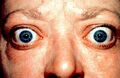 Proptosis and lid retraction from Graves' Disease


Medical Disclaimer: WikiMD is for informational purposes only and is not a substitute for professional medical advice. Content may be inaccurate or outdated and should not be used for diagnosis or treatment. Always consult your healthcare provider for medical decisions. Verify information with trusted sources such as CDC.gov and NIH.gov. By using this site, you agree that WikiMD is not liable for any outcomes related to its content. See full disclaimer.
Credits:Most images are courtesy of Wikimedia commons, and templates, categories Wikipedia, licensed under CC BY SA or similar.
Translate page: - East Asian
中文,
日本,
한국어,
South Asian
हिन्दी,
தமிழ்,
తెలుగు,
Urdu,
ಕನ್ನಡ,
Southeast Asian
Indonesian,
Vietnamese,
Thai,
မြန်မာဘာသာ,
বাংলা
European
español,
Deutsch,
français,
Greek,
português do Brasil,
polski,
română,
русский,
Nederlands,
norsk,
svenska,
suomi,
Italian
Middle Eastern & African
عربى,
Turkish,
Persian,
Hebrew,
Afrikaans,
isiZulu,
Kiswahili,
Other
Bulgarian,
Hungarian,
Czech,
Swedish,
മലയാളം,
मराठी,
ਪੰਜਾਬੀ,
ગુજરાતી,
Portuguese,
Ukrainian

