Sampling distribution
Sampling Distribution
The sampling distribution is a fundamental concept in the field of statistics that describes the distribution of a statistic (such as the mean, variance, or proportion) over many samples drawn from the same population. Understanding sampling distributions is crucial for making inferences about a population from sample data, a core aspect of statistical inference.
Definition[edit]
A sampling distribution is the probability distribution of a given statistic based on a random sample. It represents what values the statistic can take and how often it takes those values when different samples are drawn from the same population. The concept is central to the field of inferential statistics, where it underpins the logic of hypothesis testing, confidence intervals, and other statistical procedures.
Characteristics[edit]
The characteristics of a sampling distribution, such as its mean, variance, and shape, depend on the population from which samples are drawn, the size of the samples, and the statistic being considered. Two important properties of sampling distributions are:
- Central Limit Theorem (CLT): The CLT states that, for a sufficiently large sample size, the sampling distribution of the mean will be approximately normally distributed, regardless of the population's distribution. This theorem is a cornerstone of statistical theory, enabling the use of normal distribution-based methods for inference even when the population distribution is unknown.
- Standard Error: The standard error measures the variability of a statistic from sample to sample. It is related to the standard deviation of the sampling distribution and decreases as the sample size increases.
Types of Sampling Distributions[edit]
There are several types of sampling distributions, each associated with a different statistic. Some common examples include:
- Sampling Distribution of the Mean: The distribution of sample means over all possible samples of a fixed size from a population.
- Sampling Distribution of the Proportion: The distribution of sample proportions, useful in scenarios where the variable of interest is categorical.
- Sampling Distribution of the Difference Between Means: This distribution is used when comparing the means of two independent samples.
- Sampling Distribution of the Variance: The distribution of sample variances, which can be used to make inferences about the population variance.
Applications[edit]
Sampling distributions are used in various statistical procedures, including:
- Estimating population parameters (e.g., using sample means to estimate population means).
- Hypothesis testing (e.g., testing assumptions about population parameters).
- Constructing confidence intervals (e.g., intervals within which the population parameter is expected to lie with a certain level of confidence).
Conclusion[edit]
The concept of sampling distributions is pivotal in statistics, providing a foundation for making inferences about populations based on sample data. By understanding the behavior of sampling distributions, statisticians can apply appropriate methods to estimate population parameters, test hypotheses, and quantify the uncertainty of their inferences.

This article is a statistics-related stub. You can help WikiMD by expanding it!
Sampling distribution gallery[edit]
-
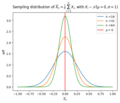 Sampling distribution

Ad. Transform your health with W8MD Weight Loss, Sleep & MedSpa

Tired of being overweight?
Get started with evidence based, physician-supervised
affordable GLP-1 weight loss injections
Now available in New York City and Philadelphia:
- Semaglutide starting from $59.99/week and up
- Tirzepatide starting from $69.99/week and up (dose dependent)
✔ Evidence-based medical weight loss ✔ Insurance-friendly visits available ✔ Same-week appointments, evenings & weekends
Learn more:
Start your transformation today with W8MD weight loss centers.
|
WikiMD Medical Encyclopedia |
Medical Disclaimer: WikiMD is for informational purposes only and is not a substitute for professional medical advice. Content may be inaccurate or outdated and should not be used for diagnosis or treatment. Always consult your healthcare provider for medical decisions. Verify information with trusted sources such as CDC.gov and NIH.gov. By using this site, you agree that WikiMD is not liable for any outcomes related to its content. See full disclaimer.
Credits:Most images are courtesy of Wikimedia commons, and templates, categories Wikipedia, licensed under CC BY SA or similar.
Translate this page: - East Asian
中文,
日本,
한국어,
South Asian
हिन्दी,
தமிழ்,
తెలుగు,
Urdu,
ಕನ್ನಡ,
Southeast Asian
Indonesian,
Vietnamese,
Thai,
မြန်မာဘာသာ,
বাংলা
European
español,
Deutsch,
français,
Greek,
português do Brasil,
polski,
română,
русский,
Nederlands,
norsk,
svenska,
suomi,
Italian
Middle Eastern & African
عربى,
Turkish,
Persian,
Hebrew,
Afrikaans,
isiZulu,
Kiswahili,
Other
Bulgarian,
Hungarian,
Czech,
Swedish,
മലയാളം,
मराठी,
ਪੰਜਾਬੀ,
ગુજરાતી,
Portuguese,
Ukrainian
