Salting (food)
Salting (food) is a method of food preservation that involves the application of salt to food. This method has been used for centuries and is still widely practiced today. The primary purpose of salting food is to prevent the growth of microorganisms, thereby extending the food's shelf life.
Etymology[edit]
The term "salting" comes from the Old English word "sealtian", which means "to salt". The practice of salting food dates back to ancient times, with evidence of its use found in various cultures around the world.
Process[edit]
The process of salting food involves applying salt to the food's surface. The salt draws out moisture from the food through the process of osmosis, creating an environment that is inhospitable to most microorganisms. This effectively preserves the food, allowing it to be stored for extended periods without spoiling.
Types of Salting[edit]
There are two main types of salting: dry salting and wet salting.
Dry Salting[edit]
In dry salting, the food is covered with salt and left to sit for a period of time. The salt draws out the moisture, preserving the food. This method is commonly used for foods like meat and fish.
Wet Salting[edit]
In wet salting, also known as brining, the food is submerged in a solution of salt and water. This method is often used for foods like vegetables and cheese.
Salting Meat[edit]
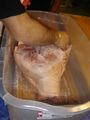
Salting meat is a common practice in many cultures. The salt not only preserves the meat, but also enhances its flavor. The process involves applying salt to the meat's surface, which draws out moisture and prevents the growth of microorganisms. This allows the meat to be stored for extended periods without spoiling.
Health Implications[edit]
While salting food can help preserve it and enhance its flavor, it can also increase the food's sodium content. High sodium intake can lead to health issues such as high blood pressure and heart disease. Therefore, it's important to consume salted foods in moderation.
See Also[edit]

This WikiMD article can only be edited by registered and verified editors. You can log in or register.
Salting (food)[edit]
-
 Prosciutto with sea salt
 -
 Prague powder No. 1
 -
 Salting (food)


Sponsored Health Resource

W8MD Weight Loss, Sleep & MedSpa
Looking for physician-supervised weight loss, semaglutide, tirzepatide, or GLP-1 receptor agonist options? W8MD helps eligible patients in New York City, Brooklyn, New Jersey, Connecticut, Pennsylvania, Delaware, and greater Philadelphia with medical weight loss, sleep medicine, and long-term maintenance support.
GLP-1 specials: Affordable GLP-1 injections NYC and Philadelphia starting from $29.99/week and up for semaglutide with insurance accepted for qualifying visits, and $45/week and up for tirzepatide with insurance accepted for qualifying visits. Self-pay options start from $59.99/week and up for semaglutide and $69.99/week and up for tirzepatide.
Medical weight loss NYC | Affordable GLP-1 injections NYC | Budget GLP-1 weight loss shots Philadelphia | New Jersey medical weight loss | NYC medical weight loss | Philadelphia medical weight loss | Sleep clinic NYC | W8MD's Philadelphia GLP-1 doctor | Weight loss prescriptions NYC
Book a W8MD appointment · View GLP-1 specials
Paid promotional message. Eligibility, pricing, insurance coverage, medication availability, and results vary. Medical evaluation required.

Medical Disclaimer: WikiMD is for informational purposes only and is not a substitute for professional medical advice. Content may be inaccurate or outdated and should not be used for diagnosis or treatment. Always consult your healthcare provider for medical decisions. Verify information with trusted sources such as CDC.gov and NIH.gov. By using this site, you agree that WikiMD is not liable for any outcomes related to its content. See full disclaimer.
Credits:Most images are courtesy of Wikimedia commons, and templates, categories Wikipedia, licensed under CC BY SA or similar.
Translate page: - East Asian
中文,
日本,
한국어,
South Asian
हिन्दी,
தமிழ்,
తెలుగు,
Urdu,
ಕನ್ನಡ,
Southeast Asian
Indonesian,
Vietnamese,
Thai,
မြန်မာဘာသာ,
বাংলা
European
español,
Deutsch,
français,
Greek,
português do Brasil,
polski,
română,
русский,
Nederlands,
norsk,
svenska,
suomi,
Italian
Middle Eastern & African
عربى,
Turkish,
Persian,
Hebrew,
Afrikaans,
isiZulu,
Kiswahili,
Other
Bulgarian,
Hungarian,
Czech,
Swedish,
മലയാളം,
मराठी,
ਪੰਜਾਬੀ,
ગુજરાતી,
Portuguese,
Ukrainian

