Saeu-jeot
Saeu-jeot is a traditional Korean fermented food product made from salted shrimp. It is a type of jeotgal, a category of salted and fermented dishes in Korean cuisine. Saeu-jeot is widely used as a seasoning and a condiment in various Korean dishes, such as kimchi, soups, and stews.
History[edit]
The history of saeu-jeot dates back to the Three Kingdoms period (57 BC – 668 AD). The method of making saeu-jeot was recorded in the Samguk Sagi, a historical record of the Three Kingdoms of Korea.
Preparation[edit]
Saeu-jeot is prepared by fermenting salted shrimp. The shrimp used in saeu-jeot are small, about 1 cm long. The shrimp are mixed with salt, usually in a ratio of about 2:1 by weight. The mixture is then fermented in a jangdok, a traditional Korean earthenware crock, for several months. The fermentation process produces a salty, flavorful liquid, which is the saeu-jeot.
Culinary uses[edit]
Saeu-jeot is a key ingredient in many Korean dishes. It is used as a seasoning in kimchi, adding a depth of flavor to the fermented vegetable dish. It is also used in various soups and stews, such as doenjang jjigae, a fermented soybean paste stew, and sundubu jjigae, a soft tofu stew. In addition, saeu-jeot can be used as a dipping sauce for grilled meats and vegetables.
See also[edit]

Saeu-jeot[edit]
-
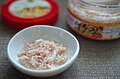 Saeu-jeot
_jeotgal_(Caridea)_3.jpg)
Advertise on WikiMD — 81,000+ full articles, ~900,000 total pages, ~250 million page views. Global reach, limited time promotional rates from $1/page/day. Learn more · View stats

Translate page: - East Asian
中文,
日本,
한국어,
South Asian
हिन्दी,
தமிழ்,
తెలుగు,
Urdu,
ಕನ್ನಡ,
Southeast Asian
Indonesian,
Vietnamese,
Thai,
မြန်မာဘာသာ,
বাংলা
European
español,
Deutsch,
français,
Greek,
português do Brasil,
polski,
română,
русский,
Nederlands,
norsk,
svenska,
suomi,
Italian
Middle Eastern & African
عربى,
Turkish,
Persian,
Hebrew,
Afrikaans,
isiZulu,
Kiswahili,
Other
Bulgarian,
Hungarian,
Czech,
Swedish,
മലയാളം,
मराठी,
ਪੰਜਾਬੀ,
ગુજરાતી,
Portuguese,
Ukrainian
About WikiMD • Contact • Disclaimer • Privacy • Copyright • Site statistics
Some content and images may originate from Wikimedia Commons or Wikipedia and remain subject to their stated licenses. Unless otherwise noted, eligible WikiMD content is available under CC BY-SA 4.0.
WikiMD Wellnesspedia — Free health & wellness information for patients, students, and health professionals.

