Three Kingdoms of Korea
Three Kingdoms of Korea refers to the three kingdoms of Goguryeo, Baekje, and Silla, which dominated the Korean peninsula and parts of Manchuria from the 1st century BC to the 7th century AD. These kingdoms were significant in the region's history, each contributing to the development of Korean culture and identity.
Goguryeo[edit]
Goguryeo (37 BC – 668 AD) was the northernmost of the three kingdoms. It was a powerful empire and one of the great powers in East Asia, until it was defeated by a Silla-Tang alliance in 668. Goguryeo was known for its military prowess, and its cultural achievements include the Goguryeo tombs, a UNESCO World Heritage Site.
Baekje[edit]
Baekje (18 BC – 660 AD) was located in the southwestern region of the Korean peninsula. It was a maritime power and had strong ties with China and Japan. Baekje played a significant role in transmitting cultural developments, including Buddhism, to Japan. The Baekje Historic Areas are a UNESCO World Heritage Site.
Silla[edit]
Silla (57 BC – 935 AD) was the smallest and the last of the three kingdoms to be established, but it was the first to adopt Buddhism as a state religion. Silla eventually conquered the other two kingdoms and unified the Korean peninsula under the rule of the Unified Silla dynasty. The historic city of Gyeongju, the capital of Silla, is a UNESCO World Heritage Site.
Legacy[edit]
The Three Kingdoms period is a significant era in Korean history. It saw the flowering of Korean culture, the growth of Buddhism, and the development of distinctive political institutions. The period also laid the groundwork for the later unification of the Korean peninsula.
See also[edit]
 | This Korean history-related article is a stub. You can help WikiMD by expanding the page. |
-
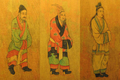 7th century painting of Koreans
 -
The Ancient Map of the Three Kingdoms of Korea
-
Goguryeo tomb mural
-
Baekje Gilt-bronze Incense Burner
-
Pensive Bodhisattva
-
Gaya Warrior
-
Three Kingdoms of Korea
-
Yangdong Village in Gyeongju
-
Goguryeo Roof Tiles


Medical Disclaimer: WikiMD is for informational purposes only and is not a substitute for professional medical advice. Content may be inaccurate or outdated and should not be used for diagnosis or treatment. Always consult your healthcare provider for medical decisions. Verify information with trusted sources such as CDC.gov and NIH.gov. By using this site, you agree that WikiMD is not liable for any outcomes related to its content. See full disclaimer.
Credits:Most images are courtesy of Wikimedia commons, and templates, categories Wikipedia, licensed under CC BY SA or similar.
Translate page: - East Asian
中文,
日本,
한국어,
South Asian
हिन्दी,
தமிழ்,
తెలుగు,
Urdu,
ಕನ್ನಡ,
Southeast Asian
Indonesian,
Vietnamese,
Thai,
မြန်မာဘာသာ,
বাংলা
European
español,
Deutsch,
français,
Greek,
português do Brasil,
polski,
română,
русский,
Nederlands,
norsk,
svenska,
suomi,
Italian
Middle Eastern & African
عربى,
Turkish,
Persian,
Hebrew,
Afrikaans,
isiZulu,
Kiswahili,
Other
Bulgarian,
Hungarian,
Czech,
Swedish,
മലയാളം,
मराठी,
ਪੰਜਾਬੀ,
ગુજરાતી,
Portuguese,
Ukrainian


