Rotenone
Rotenone is a naturally occurring compound that is used as an insecticide and pesticide. It is found in the roots and stems of several plants such as the jicama vine plant and the roots of several members of Fabaceae.
History[edit]
Rotenone was first isolated in 1895 by a French scientist, but its insecticidal properties were not recognized until the 20th century. It was first used as a broad-spectrum insecticide in the 1930s.
Uses[edit]
Rotenone is used in gardens, around homes, and in agriculture because it is effective against a wide range of insects. It is also used in fish management as a piscicide.
Mechanism of action[edit]
Rotenone works by interfering with the electron transport chain in mitochondria. It inhibits the transfer of electrons from iron-sulfur centers in complex I to ubiquinone. This stops the production of ATP, causing the death of the cell and the organism.
Safety[edit]
Rotenone is toxic to fish and insects, but it is less harmful to mammals and birds because they can break it down more quickly. However, it can still be harmful if it is inhaled, ingested, or comes into contact with the skin.
Environmental impact[edit]
Rotenone breaks down quickly in the environment and does not accumulate in the food chain. However, it can still have a negative impact on non-target species if it is not used carefully.
See also[edit]

This WikiMD article can only be edited by registered and verified editors. You can log in or register.
Rotenone[edit]
-
 Rotenone Structural Formula
 -
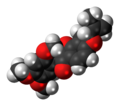 Rotenone 3D Spacefill


Advertise on WikiMD — 81,000+ full articles, ~900,000 total pages, ~250 million page views. Global reach, limited time promotional rates from $1/page/day. Learn more · View stats

Medical Disclaimer: WikiMD is for informational purposes only and is not a substitute for professional medical advice. Content may be inaccurate or outdated and should not be used for diagnosis or treatment. Always consult your healthcare provider for medical decisions. Verify information with trusted sources such as CDC.gov and NIH.gov. By using this site, you agree that WikiMD is not liable for any outcomes related to its content. See full disclaimer.
Credits:Most images are courtesy of Wikimedia commons, and templates, categories Wikipedia, licensed under CC BY SA or similar.
Translate page: - East Asian
中文,
日本,
한국어,
South Asian
हिन्दी,
தமிழ்,
తెలుగు,
Urdu,
ಕನ್ನಡ,
Southeast Asian
Indonesian,
Vietnamese,
Thai,
မြန်မာဘာသာ,
বাংলা
European
español,
Deutsch,
français,
Greek,
português do Brasil,
polski,
română,
русский,
Nederlands,
norsk,
svenska,
suomi,
Italian
Middle Eastern & African
عربى,
Turkish,
Persian,
Hebrew,
Afrikaans,
isiZulu,
Kiswahili,
Other
Bulgarian,
Hungarian,
Czech,
Swedish,
മലയാളം,
मराठी,
ਪੰਜਾਬੀ,
ગુજરાતી,
Portuguese,
Ukrainian

