Relative energy deficiency in sport
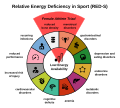
Relative Energy Deficiency in Sport (RED-S) is a syndrome resulting from insufficient caloric intake relative to the energy expended by an athlete, leading to impaired physiological functioning. This condition encompasses a wide range of health and performance consequences, including but not limited to alterations in hormones, menstrual function, bone health, immunity, protein synthesis, and cardiovascular health. RED-S is an evolution of the concept previously known as the Female Athlete Triad, expanding its scope to include male athletes and a broader spectrum of health consequences beyond menstrual dysfunction, low energy availability, and decreased bone mineral density.
Definition and Causes[edit]
Relative Energy Deficiency in Sport is defined by the International Olympic Committee (IOC) as the result of insufficient caloric intake and/or excessive energy expenditure. It does not exclusively pertain to athletes with eating disorders, although individuals with such disorders are at a higher risk. RED-S can be intentional, stemming from an athlete's desire to alter body composition for performance or aesthetic reasons, or unintentional, due to a lack of awareness or understanding of nutritional needs.
Health Consequences[edit]
The health consequences of RED-S are extensive and impact multiple body systems. Key areas affected include:
- Endocrine Function: Reduced energy availability can lead to alterations in the hypothalamic-pituitary axis, affecting hormones such as leptin, ghrelin, insulin, and reproductive hormones, which can result in menstrual dysfunction in females and decreased testosterone in males.
- Bone Health: Chronic low energy availability can lead to decreased bone mineral density, increasing the risk of osteoporosis and fractures.
- Cardiovascular Health: RED-S can lead to changes in heart rate, blood pressure, and vascular function.
- Immune Function: Energy deficiency can impair immune function, increasing the risk of infections and illnesses.
- Mental Health: There is a strong association between RED-S and psychological issues such as depression, anxiety, and disordered eating behaviors.
Diagnosis and Management[edit]
Diagnosis of RED-S involves a comprehensive assessment including dietary history, exercise history, psychological assessment, and physiological measurements. Early detection and intervention are crucial for preventing long-term health consequences. Management of RED-S requires a multidisciplinary approach involving nutritionists, physicians, psychologists, and sport coaches. The primary goal is to restore energy balance either by increasing energy intake, reducing energy expenditure, or a combination of both.
Prevention[edit]
Prevention strategies for RED-S include education of athletes, coaches, and healthcare providers on the importance of adequate energy intake and the risks associated with energy deficiency. Regular monitoring of athletes' health and performance can also help in early detection and prevention of RED-S.
See Also[edit]

-
 Relative energy deficiency in sport

Ad. Transform your health with W8MD Weight Loss, Sleep & MedSpa

Tired of being overweight?
Special offer:
Budget GLP-1 weight loss medications
- Semaglutide starting from $29.99/week and up with insurance for visit of $59.99 and up per week self pay.
- Tirzepatide starting from $45.00/week and up (dose dependent) or $69.99/week and up self pay
✔ Same-week appointments, evenings & weekends
Learn more:
- GLP-1 weight loss clinic NYC
- W8MD's NYC medical weight loss
- W8MD Philadelphia GLP-1 shots
- Philadelphia GLP-1 injections
- Affordable GLP-1 shots NYC
|
WikiMD Medical Encyclopedia |
Medical Disclaimer: WikiMD is for informational purposes only and is not a substitute for professional medical advice. Content may be inaccurate or outdated and should not be used for diagnosis or treatment. Always consult your healthcare provider for medical decisions. Verify information with trusted sources such as CDC.gov and NIH.gov. By using this site, you agree that WikiMD is not liable for any outcomes related to its content. See full disclaimer.
Credits:Most images are courtesy of Wikimedia commons, and templates, categories Wikipedia, licensed under CC BY SA or similar.
Translate this page: - East Asian
中文,
日本,
한국어,
South Asian
हिन्दी,
தமிழ்,
తెలుగు,
Urdu,
ಕನ್ನಡ,
Southeast Asian
Indonesian,
Vietnamese,
Thai,
မြန်မာဘာသာ,
বাংলা
European
español,
Deutsch,
français,
Greek,
português do Brasil,
polski,
română,
русский,
Nederlands,
norsk,
svenska,
suomi,
Italian
Middle Eastern & African
عربى,
Turkish,
Persian,
Hebrew,
Afrikaans,
isiZulu,
Kiswahili,
Other
Bulgarian,
Hungarian,
Czech,
Swedish,
മലയാളം,
मराठी,
ਪੰਜਾਬੀ,
ગુજરાતી,
Portuguese,
Ukrainian
