Radial notch
Radial Notch is a prominent structure found in the ulna, one of the two bones of the forearm. It is a small, smooth, circular depression found on the lateral side of the coronoid process, and it articulates with the head of the radius to form the proximal radioulnar joint.
Etymology[edit]
The term "radial notch" is derived from its location and function. "Radial" refers to the radius, the bone with which the notch articulates, and "notch" refers to the depression in the bone where this articulation occurs.
Anatomy[edit]
The radial notch is located on the lateral side of the coronoid process of the ulna. It is a small, smooth, circular depression that is designed to accommodate the head of the radius. This articulation forms the proximal radioulnar joint, which allows for the rotation of the forearm.
The radial notch is bordered by the olecranon and the coronoid process, two prominent features of the ulna. The olecranon forms the tip of the elbow and provides a surface for the attachment of the triceps brachii muscle, while the coronoid process provides a surface for the attachment of the brachialis muscle.
Clinical Significance[edit]
Injuries or abnormalities of the radial notch can lead to a range of clinical conditions. For example, a fracture that extends into the radial notch can disrupt the proximal radioulnar joint, leading to a loss of forearm rotation. This condition is known as a Monteggia fracture.
Similarly, arthritis of the proximal radioulnar joint can cause pain and loss of rotation. This condition is often treated with a surgical procedure known as a radial head replacement, in which the head of the radius is replaced with a metal or plastic prosthesis.
See Also[edit]

This WikiMD article can only be edited by registered and verified editors. You can log in or register.
Radial_notch[edit]
-
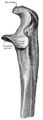 Gray212
 -
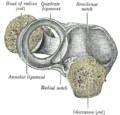 Gray333


Advertise on WikiMD — 81,000+ full articles, ~900,000 total pages, ~250 million page views. Global reach, limited time promotional rates from $1/page/day. Learn more · View stats


Translate page: - East Asian
中文,
日本,
한국어,
South Asian
हिन्दी,
தமிழ்,
తెలుగు,
Urdu,
ಕನ್ನಡ,
Southeast Asian
Indonesian,
Vietnamese,
Thai,
မြန်မာဘာသာ,
বাংলা
European
español,
Deutsch,
français,
Greek,
português do Brasil,
polski,
română,
русский,
Nederlands,
norsk,
svenska,
suomi,
Italian
Middle Eastern & African
عربى,
Turkish,
Persian,
Hebrew,
Afrikaans,
isiZulu,
Kiswahili,
Other
Bulgarian,
Hungarian,
Czech,
Swedish,
മലയാളം,
मराठी,
ਪੰਜਾਬੀ,
ગુજરાતી,
Portuguese,
Ukrainian
About WikiMD • Contact • Disclaimer • Privacy • Copyright • Site statistics
Some content and images may originate from Wikimedia Commons or Wikipedia and remain subject to their stated licenses. Unless otherwise noted, eligible WikiMD content is available under CC BY-SA 4.0.
WikiMD Wellnesspedia — Free health & wellness information for patients, students, and health professionals.

