Proximal radioulnar articulation
The proximal radioulnar articulation is a joint located between the radius and ulna bones in the forearm. It allows for rotational movement of the forearm, enabling the hand to be turned palm up (supination) or palm down (pronation). This joint is an essential component of the complex movements performed by the forearm and wrist.
Anatomy[edit]
The proximal radioulnar articulation consists of two main components: the radial notch of the ulna and the head of the radius. The radial notch is a concave depression located on the medial side of the ulna, while the head of the radius is a rounded structure that fits into the radial notch. The joint is stabilized by several ligaments, including the annular ligament, which encircles the head of the radius and holds it in place.
Function[edit]
The primary function of the proximal radioulnar articulation is to allow for pronation and supination of the forearm. Pronation refers to the movement of the forearm that turns the palm of the hand downward, while supination refers to the movement that turns the palm upward. These movements are crucial for various activities, such as writing, typing, and grasping objects.
Clinical Significance[edit]
Injuries to the proximal radioulnar articulation can occur due to trauma or repetitive stress. Common injuries include dislocation, subluxation, and ligament tears. These injuries can cause pain, limited range of motion, and functional impairment. Treatment options may include immobilization, physical therapy, or in severe cases, surgical intervention.
See Also[edit]
References[edit]
-
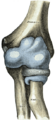 Proximal radioulnar articulation
 -
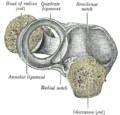 Proximal radioulnar articulation


Medical Disclaimer: WikiMD is for informational purposes only and is not a substitute for professional medical advice. Content may be inaccurate or outdated and should not be used for diagnosis or treatment. Always consult your healthcare provider for medical decisions. Verify information with trusted sources such as CDC.gov and NIH.gov. By using this site, you agree that WikiMD is not liable for any outcomes related to its content. See full disclaimer.
Credits:Most images are courtesy of Wikimedia commons, and templates, categories Wikipedia, licensed under CC BY SA or similar.
Translate page: - East Asian
中文,
日本,
한국어,
South Asian
हिन्दी,
தமிழ்,
తెలుగు,
Urdu,
ಕನ್ನಡ,
Southeast Asian
Indonesian,
Vietnamese,
Thai,
မြန်မာဘာသာ,
বাংলা
European
español,
Deutsch,
français,
Greek,
português do Brasil,
polski,
română,
русский,
Nederlands,
norsk,
svenska,
suomi,
Italian
Middle Eastern & African
عربى,
Turkish,
Persian,
Hebrew,
Afrikaans,
isiZulu,
Kiswahili,
Other
Bulgarian,
Hungarian,
Czech,
Swedish,
മലയാളം,
मराठी,
ਪੰਜਾਬੀ,
ગુજરાતી,
Portuguese,
Ukrainian

