Quantitative psychology
Quantitative psychology is a field of psychology that involves the application of statistical analysis to psychological research, and the development of novel statistical methods for measuring and explaining human behavior. It is a highly interdisciplinary field, drawing on methods from both mathematics and psychology.
History[edit]
Quantitative psychology has its roots in the early 20th century, when psychologists began to use statistical methods to analyze their data. The field grew rapidly with the development of psychometrics, the science of measuring mental capacities, and the invention of the factor analysis, a statistical method for studying the relationships among variables.
Methods[edit]
Quantitative psychologists use a variety of methods to analyze data, including descriptive statistics, inferential statistics, and multivariate statistics. They also use psychometric theory to develop and validate measures of psychological constructs.
Applications[edit]
Quantitative psychology has many applications in both research and practice. For example, it is used in educational psychology to develop and validate tests of intelligence and achievement, in clinical psychology to measure the effectiveness of treatments, and in social psychology to study the relationships among social variables.
Training and Careers[edit]
Training in quantitative psychology typically involves coursework in statistics, research methods, and psychometrics, as well as practical experience in data analysis. Many quantitative psychologists work in academic settings, where they teach and conduct research. Others work in industry, government, or private consulting, where they apply their skills to practical problems.
See Also[edit]
References[edit]
<references />
 | This psychology-related article is a stub. You can help WikiMD by expanding the page. |
 | This statistics-related article is a stub. You can help WikiMD by expanding the page. |
-
 Galton's correlation diagram 1875
 -
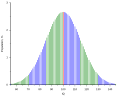 IQ curve
 -
 Peabody Vocabulary Test
 -
 Social network diagram


Medical Disclaimer: WikiMD is for informational purposes only and is not a substitute for professional medical advice. Content may be inaccurate or outdated and should not be used for diagnosis or treatment. Always consult your healthcare provider for medical decisions. Verify information with trusted sources such as CDC.gov and NIH.gov. By using this site, you agree that WikiMD is not liable for any outcomes related to its content. See full disclaimer.
Credits:Most images are courtesy of Wikimedia commons, and templates, categories Wikipedia, licensed under CC BY SA or similar.
Translate this page: - East Asian
中文,
日本,
한국어,
South Asian
हिन्दी,
தமிழ்,
తెలుగు,
Urdu,
ಕನ್ನಡ,
Southeast Asian
Indonesian,
Vietnamese,
Thai,
မြန်မာဘာသာ,
বাংলা
European
español,
Deutsch,
français,
Greek,
português do Brasil,
polski,
română,
русский,
Nederlands,
norsk,
svenska,
suomi,
Italian
Middle Eastern & African
عربى,
Turkish,
Persian,
Hebrew,
Afrikaans,
isiZulu,
Kiswahili,
Other
Bulgarian,
Hungarian,
Czech,
Swedish,
മലയാളം,
मराठी,
ਪੰਜਾਬੀ,
ગુજરાતી,
Portuguese,
Ukrainian
