Pseudouridine

Pseudouridine (Ψ), found in the nucleic acid of RNA, is one of the most abundant modifications across all forms of life. It is an isomer of the nucleoside uridine in which the uracil is attached to the 5' ribose carbon instead of the normal 9' position. This alteration leads to a C-glycosidic bond formation, distinguishing it structurally and chemically from uridine. Pseudouridine is often referred to as the "fifth nucleotide" due to its pervasive presence in RNA molecules and its significant roles in the structure and function of various RNA species.
Biosynthesis and Function[edit]
Pseudouridine is synthesized from uridine by the action of enzymes called pseudouridine synthases. These enzymes catalyze the isomerization of uridine to pseudouridine within RNA chains, a process that does not require the cleavage of the phosphodiester backbone of RNA. This modification can occur post-transcriptionally in various types of RNA, including tRNA, rRNA, and snRNA, enhancing the stability and function of these molecules.
The presence of pseudouridine in RNA molecules has been linked to several critical functions. In tRNA, pseudouridine contributes to the proper folding and stability of the molecule, which is essential for its role in protein synthesis. In rRNA, it plays a part in the maintenance of the ribosome's structure and in the accuracy of translation. Pseudouridine has also been implicated in the splicing efficiency of snRNA and in the regulation of gene expression.
Detection and Analysis[edit]
The detection and quantification of pseudouridine in RNA have been facilitated by various analytical techniques, including mass spectrometry and specific chemical reactions that distinguish pseudouridine from uridine. Advances in high-throughput sequencing technologies have also enabled the mapping of pseudouridine sites across different types of RNA, providing insights into its widespread distribution and functional roles.
Clinical Significance[edit]
Alterations in the levels of pseudouridine and mutations in pseudouridine synthases have been associated with several human diseases, including cancer, mitochondrial disorders, and dyskeratosis congenita, a rare genetic disorder characterized by bone marrow failure and increased cancer risk. These associations highlight the importance of pseudouridine and its modifying enzymes in maintaining cellular health and homeostasis.
Conclusion[edit]
Pseudouridine is a fundamental component of RNA that contributes to the molecule's structure, stability, and function. Its widespread presence across different RNA species and its involvement in critical cellular processes underscore its importance in the biology of all living organisms. Ongoing research into the roles of pseudouridine and its potential as a biomarker for disease continues to reveal the complexity and significance of RNA modifications.
.svg) | This biochemistry article is a stub. You can help WikiMD by expanding the page. |
-
 Pseudouridine synthase enzyme structure
 -
 Yeast tRNA-Ala secondary structure
 -
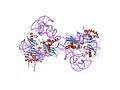 Crystal structure of pseudouridine synthase


Medical Disclaimer: WikiMD is for informational purposes only and is not a substitute for professional medical advice. Content may be inaccurate or outdated and should not be used for diagnosis or treatment. Always consult your healthcare provider for medical decisions. Verify information with trusted sources such as CDC.gov and NIH.gov. By using this site, you agree that WikiMD is not liable for any outcomes related to its content. See full disclaimer.
Credits:Most images are courtesy of Wikimedia commons, and templates, categories Wikipedia, licensed under CC BY SA or similar.
Translate page: - East Asian
中文,
日本,
한국어,
South Asian
हिन्दी,
தமிழ்,
తెలుగు,
Urdu,
ಕನ್ನಡ,
Southeast Asian
Indonesian,
Vietnamese,
Thai,
မြန်မာဘာသာ,
বাংলা
European
español,
Deutsch,
français,
Greek,
português do Brasil,
polski,
română,
русский,
Nederlands,
norsk,
svenska,
suomi,
Italian
Middle Eastern & African
عربى,
Turkish,
Persian,
Hebrew,
Afrikaans,
isiZulu,
Kiswahili,
Other
Bulgarian,
Hungarian,
Czech,
Swedish,
മലയാളം,
मराठी,
ਪੰਜਾਬੀ,
ગુજરાતી,
Portuguese,
Ukrainian

