Protein primary structure
Protein primary structure refers to the linear sequence of amino acids that make up a protein molecule. This sequence is critical as it determines the protein's three-dimensional structure and, consequently, its function. The primary structure is encoded directly by the gene sequence and is the first level of protein structure, followed by secondary, tertiary, and quaternary structures.
Overview[edit]
The primary structure of a protein is formed by covalently bonded amino acids through peptide bonds. A peptide bond is a chemical bond formed between the carboxyl group of one amino acid and the amino group of another. The sequence of amino acids in the primary structure is read from the N-terminal end, containing the free amino group, to the C-terminal end, containing the free carboxyl group.
Importance of Primary Structure[edit]
The sequence of amino acids in the primary structure is crucial for the protein's overall structure and function. Even a single change in the amino acid sequence can significantly affect the protein's properties, as seen in various genetic disorders. For example, the substitution of valine for glutamic acid in the β-globin chain of hemoglobin leads to sickle cell anemia, a disease characterized by deformed red blood cells.
Determination of Primary Structure[edit]
The primary structure of a protein can be determined using techniques such as Edman degradation or mass spectrometry. Edman degradation sequentially removes one residue at a time from the amino end of a peptide, allowing the identification of the amino acid sequence. Mass spectrometry, on the other hand, can provide information about the molecular weight and sequence of peptides and proteins.
Bioinformatics and Primary Structure[edit]
With the advent of bioinformatics, computational methods have become invaluable in predicting and analyzing the primary structure of proteins. Databases such as the Protein Data Bank (PDB) and tools like BLAST (Basic Local Alignment Search Tool) enable researchers to compare protein sequences, predict functions, and understand evolutionary relationships.
Implications of Primary Structure in Biotechnology[edit]
Understanding the primary structure of proteins has significant implications in biotechnology and medicine. It allows for the design of recombinant DNA technology to produce synthetic proteins with desired properties. Moreover, it aids in the development of novel therapeutic strategies, including the design of peptide-based drugs and vaccines.
Conclusion[edit]
The primary structure of a protein is a fundamental aspect that dictates its structure and function. Advances in analytical techniques and bioinformatics have greatly enhanced our understanding of protein sequences and their implications in health and disease.
.svg) | This biochemistry article is a stub. You can help WikiMD by expanding the page. |
-
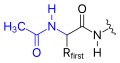 N-terminal acetylation
 -
 Formation of pyroglutamate
 -
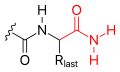 C-terminal amidation


Medical Disclaimer: WikiMD is for informational purposes only and is not a substitute for professional medical advice. Content may be inaccurate or outdated and should not be used for diagnosis or treatment. Always consult your healthcare provider for medical decisions. Verify information with trusted sources such as CDC.gov and NIH.gov. By using this site, you agree that WikiMD is not liable for any outcomes related to its content. See full disclaimer.
Credits:Most images are courtesy of Wikimedia commons, and templates, categories Wikipedia, licensed under CC BY SA or similar.
Translate page: - East Asian
中文,
日本,
한국어,
South Asian
हिन्दी,
தமிழ்,
తెలుగు,
Urdu,
ಕನ್ನಡ,
Southeast Asian
Indonesian,
Vietnamese,
Thai,
မြန်မာဘာသာ,
বাংলা
European
español,
Deutsch,
français,
Greek,
português do Brasil,
polski,
română,
русский,
Nederlands,
norsk,
svenska,
suomi,
Italian
Middle Eastern & African
عربى,
Turkish,
Persian,
Hebrew,
Afrikaans,
isiZulu,
Kiswahili,
Other
Bulgarian,
Hungarian,
Czech,
Swedish,
മലയാളം,
मराठी,
ਪੰਜਾਬੀ,
ગુજરાતી,
Portuguese,
Ukrainian

