Protein complex
Protein complex or protein assembly is a group of two or more proteins that bind together, often to carry out a specific function. There are several different types of protein complexes, including enzyme complexes, structural protein complexes, and transport protein complexes.
Structure[edit]
Protein complexes can be composed of identical proteins (homomers) or different proteins (heteromers). The proteins in a complex are held together by protein-protein interactions, which can involve hydrogen bonds, ionic bonds, disulfide bonds, and hydrophobic interactions.
Function[edit]
Protein complexes carry out a wide range of functions in the cell. Some protein complexes, such as ribosomes, are involved in protein synthesis. Others, like the proteasome, are involved in protein degradation. Protein complexes also play key roles in cell signaling, DNA replication, and cell division.
Examples[edit]
Some examples of protein complexes include:
- Hemoglobin, a protein complex that carries oxygen in the blood
- Photosystem II, a protein complex involved in photosynthesis
- DNA polymerase, a protein complex involved in DNA replication
- ATP synthase, a protein complex that generates ATP
See also[edit]

This WikiMD article can only be edited by registered and verified editors. You can log in or register.
References[edit]
External links[edit]
- Protein Complexes and Functional Genomics - An article from the National Center for Biotechnology Information
- Protein Complex - A topic page from ScienceDirect
This page was last edited on 1 January 2022, at 00:00 (UTC). Text is available under the Creative Commons Attribution-ShareAlike License; additional terms may apply. By using this site, you agree to the Terms of Use and Privacy Policy. Wikipedia® is a registered trademark of the Wikimedia Foundation, Inc., a non-profit organization.
-
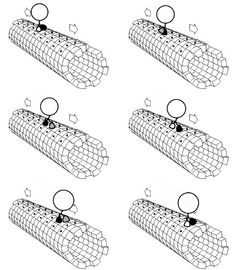 Kinesin walking along a microtubule
 -
 Barnase-barstar complex
 -
 Essential proteins in yeast complexes


Medical Disclaimer: WikiMD is for informational purposes only and is not a substitute for professional medical advice. Content may be inaccurate or outdated and should not be used for diagnosis or treatment. Always consult your healthcare provider for medical decisions. Verify information with trusted sources such as CDC.gov and NIH.gov. By using this site, you agree that WikiMD is not liable for any outcomes related to its content. See full disclaimer.
Credits:Most images are courtesy of Wikimedia commons, and templates, categories Wikipedia, licensed under CC BY SA or similar.
Translate page: - East Asian
中文,
日本,
한국어,
South Asian
हिन्दी,
தமிழ்,
తెలుగు,
Urdu,
ಕನ್ನಡ,
Southeast Asian
Indonesian,
Vietnamese,
Thai,
မြန်မာဘာသာ,
বাংলা
European
español,
Deutsch,
français,
Greek,
português do Brasil,
polski,
română,
русский,
Nederlands,
norsk,
svenska,
suomi,
Italian
Middle Eastern & African
عربى,
Turkish,
Persian,
Hebrew,
Afrikaans,
isiZulu,
Kiswahili,
Other
Bulgarian,
Hungarian,
Czech,
Swedish,
മലയാളം,
मराठी,
ਪੰਜਾਬੀ,
ગુજરાતી,
Portuguese,
Ukrainian

