Precursor cell
A precursor cell, also known as a progenitor cell, is an intermediate cell type that arises from a stem cell and is on the path to differentiating into a specific type of cell. Precursor cells are a stage of cell differentiation that is more specific than stem cells but not yet a fully differentiated cell.
Types of Precursor Cells[edit]
There are several types of precursor cells, each with the potential to differentiate into specific types of cells. These include:
- Hematopoietic Precursor Cells: These cells are capable of differentiating into various types of blood cells, including red blood cells, white blood cells, and platelets.
- Neural Precursor Cells: These cells can differentiate into the various types of cells found in the nervous system, including neurons, astrocytes, and oligodendrocytes.
- Epithelial Precursor Cells: These cells can differentiate into the various types of cells that make up the epithelium, the layer of cells that covers the body's surfaces.
Role in Development and Regeneration[edit]
Precursor cells play a crucial role in both development and regeneration. During development, precursor cells differentiate into the various types of cells needed to form the tissues and organs of the body. In regeneration, precursor cells are responsible for replacing cells that have been lost or damaged.
Research and Clinical Applications[edit]
Research into precursor cells has potential applications in regenerative medicine, where they could be used to replace damaged or lost cells in various diseases and conditions. For example, neural precursor cells could potentially be used to treat neurodegenerative diseases such as Parkinson's disease or Alzheimer's disease.
See Also[edit]
References[edit]

-
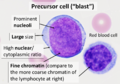 Precursor cell
 -
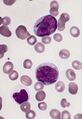 Two myeloblasts with Auer rods
_cell.png)


Medical Disclaimer: WikiMD is for informational purposes only and is not a substitute for professional medical advice. Content may be inaccurate or outdated and should not be used for diagnosis or treatment. Always consult your healthcare provider for medical decisions. Verify information with trusted sources such as CDC.gov and NIH.gov. By using this site, you agree that WikiMD is not liable for any outcomes related to its content. See full disclaimer.
Credits:Most images are courtesy of Wikimedia commons, and templates, categories Wikipedia, licensed under CC BY SA or similar.
Translate page: - East Asian
中文,
日本,
한국어,
South Asian
हिन्दी,
தமிழ்,
తెలుగు,
Urdu,
ಕನ್ನಡ,
Southeast Asian
Indonesian,
Vietnamese,
Thai,
မြန်မာဘာသာ,
বাংলা
European
español,
Deutsch,
français,
Greek,
português do Brasil,
polski,
română,
русский,
Nederlands,
norsk,
svenska,
suomi,
Italian
Middle Eastern & African
عربى,
Turkish,
Persian,
Hebrew,
Afrikaans,
isiZulu,
Kiswahili,
Other
Bulgarian,
Hungarian,
Czech,
Swedish,
മലയാളം,
मराठी,
ਪੰਜਾਬੀ,
ગુજરાતી,
Portuguese,
Ukrainian

