Cellular differentiation
Cellular Differentiation is a process in biology where a less specialized cell becomes a more specialized cell type. This process is essential for the development, growth, and maintenance of multicellular organisms.
Overview[edit]
Cellular differentiation is a vital process in multicellular organisms. It is the process by which a less specialized cell becomes a more specialized cell type. This process is controlled by the gene expression in the cell's genome. The process of cellular differentiation is essential for the development, growth, and maintenance of multicellular organisms.
Process[edit]
The process of cellular differentiation begins with a stem cell. Stem cells are unique in that they have the potential to differentiate into any cell type in the body. The process of differentiation is controlled by the gene expression in the cell's genome.
When a stem cell divides, it has the potential to either remain a stem cell or become another type of cell with a more specialized function, such as a muscle cell, red blood cell, or brain cell. This decision is controlled by signals from the surrounding cells and the environment.
Role in Development[edit]
Cellular differentiation plays a crucial role in the development of multicellular organisms. During the development of an embryo, stem cells differentiate into all the various types of cells that make up the organism. This process is tightly controlled to ensure that the right types of cells are produced at the right time and in the right place.
Role in Disease[edit]
Abnormal cellular differentiation can lead to diseases such as cancer. In cancer, cells lose their ability to differentiate properly, leading to uncontrolled cell growth and the formation of tumors.
See Also[edit]

-
 Final stem cell differentiation
 -
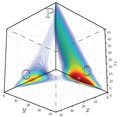 Stimuli
 -
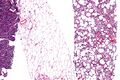 Dedifferentiated liposarcoma - intermediate magnification
 -
 Nuclear Reprogramming
 -
 Cell Differentiation
 -
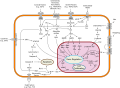 Signal transduction pathways
.svg)


Medical Disclaimer: WikiMD is for informational purposes only and is not a substitute for professional medical advice. Content may be inaccurate or outdated and should not be used for diagnosis or treatment. Always consult your healthcare provider for medical decisions. Verify information with trusted sources such as CDC.gov and NIH.gov. By using this site, you agree that WikiMD is not liable for any outcomes related to its content. See full disclaimer.
Credits:Most images are courtesy of Wikimedia commons, and templates, categories Wikipedia, licensed under CC BY SA or similar.
Translate page: - East Asian
中文,
日本,
한국어,
South Asian
हिन्दी,
தமிழ்,
తెలుగు,
Urdu,
ಕನ್ನಡ,
Southeast Asian
Indonesian,
Vietnamese,
Thai,
မြန်မာဘာသာ,
বাংলা
European
español,
Deutsch,
français,
Greek,
português do Brasil,
polski,
română,
русский,
Nederlands,
norsk,
svenska,
suomi,
Italian
Middle Eastern & African
عربى,
Turkish,
Persian,
Hebrew,
Afrikaans,
isiZulu,
Kiswahili,
Other
Bulgarian,
Hungarian,
Czech,
Swedish,
മലയാളം,
मराठी,
ਪੰਜਾਬੀ,
ગુજરાતી,
Portuguese,
Ukrainian

