Platostoma palustre
Platostoma palustre, also known as Mesona, is a species of plant in the family Lamiaceae. It is native to Southeast Asia and is commonly used in traditional medicine and as a culinary ingredient.
Description[edit]
Platostoma palustre is a perennial herb that grows up to 1.5 meters tall. It has opposite, ovate leaves that are 2-6 cm long and 1-3 cm wide. The flowers are small, white, and borne in terminal spikes. The fruit is a small, brown nutlet.
Distribution and Habitat[edit]
Platostoma palustre is native to Southeast Asia, including countries such as Malaysia, Thailand, and Vietnam. It grows in wet, marshy areas, hence the name 'palustre', which means 'of the marsh'.
Uses[edit]
Platostoma palustre is used in traditional medicine in many Asian countries. The leaves are used to treat fever, cough, and sore throat. In Traditional Chinese Medicine, it is used to clear heat and detoxify the body.
In addition to its medicinal uses, Platostoma palustre is also used in cooking. The leaves are used to make a jelly known as 'grass jelly' or 'cincau' in Indonesia and Malaysia.
Cultivation[edit]
Platostoma palustre is a hardy plant that can grow in a variety of soil types, although it prefers well-drained soil. It can be propagated by seeds or by cuttings. It requires full sun to partial shade and regular watering.
Conservation Status[edit]
While Platostoma palustre is not currently listed as threatened or endangered, its habitat is being lost due to deforestation and urbanization. Efforts are being made to conserve this species and its habitat.
See Also[edit]
References[edit]
External Links[edit]
- The Plant List: Platostoma palustre
- PubMed: Antioxidant activity of Platostoma palustre
-
 Grass jelly cultivation in Singapore
 -
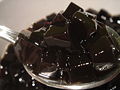 Grass Jelly Spoon
 -
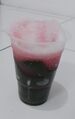 Es Cincau


Medical Disclaimer: WikiMD is for informational purposes only and is not a substitute for professional medical advice. Content may be inaccurate or outdated and should not be used for diagnosis or treatment. Always consult your healthcare provider for medical decisions. Verify information with trusted sources such as CDC.gov and NIH.gov. By using this site, you agree that WikiMD is not liable for any outcomes related to its content. See full disclaimer.
Credits:Most images are courtesy of Wikimedia commons, and templates, categories Wikipedia, licensed under CC BY SA or similar.
Translate page: - East Asian
中文,
日本,
한국어,
South Asian
हिन्दी,
தமிழ்,
తెలుగు,
Urdu,
ಕನ್ನಡ,
Southeast Asian
Indonesian,
Vietnamese,
Thai,
မြန်မာဘာသာ,
বাংলা
European
español,
Deutsch,
français,
Greek,
português do Brasil,
polski,
română,
русский,
Nederlands,
norsk,
svenska,
suomi,
Italian
Middle Eastern & African
عربى,
Turkish,
Persian,
Hebrew,
Afrikaans,
isiZulu,
Kiswahili,
Other
Bulgarian,
Hungarian,
Czech,
Swedish,
മലയാളം,
मराठी,
ਪੰਜਾਬੀ,
ગુજરાતી,
Portuguese,
Ukrainian

