Peter of Spain

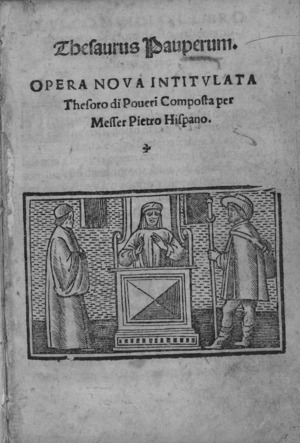
Peter of Spain (Latin: Petrus Hispanus; Portuguese: Pedro de Espanha; c. 1210/1220 – 1277) was a notable figure in the 13th century, primarily recognized for his contributions to the fields of medicine, philosophy, and logic. Despite the ambiguity surrounding his exact birthplace, it is widely accepted that he was indeed of Spanish origin. Peter of Spain's legacy is multifaceted, encompassing his role as a scholar, physician, and eventually, Pope John XXI.
Biography[edit]
The details of Peter of Spain's early life are sparse and shrouded in mystery. Born around the early 13th century, he emerged as a prominent intellectual figure in the medieval period. His education and scholarly pursuits led him to the University of Paris, where he delved into the realms of medicine, philosophy, and theology.
Academic Contributions[edit]
Peter of Spain's academic contributions are vast, with his works on logic and medicine standing out. He is best known for his treatises in logic, particularly Summulae Logicales, which served as a fundamental textbook in medieval universities for centuries. This work systematically outlines the principles of logic, including theories of syllogism, propositions, and fallacies, establishing him as a leading logician of his time.
In the field of medicine, Peter compiled and authored several medical texts, drawing upon the knowledge of ancient and contemporary sources. His works contributed to the understanding and treatment of various ailments in the medieval period, reflecting the medical practices and theories of the time.
Papacy[edit]
In a surprising turn of events, Peter of Spain was elected Pope in 1276, taking the name John XXI. His papacy was short-lived, however, lasting only from September 1276 until his death in May 1277. His tenure as Pope was marked by efforts to reconcile conflicting factions within the Church and to promote educational and administrative reforms. Unfortunately, his papacy is often overshadowed by his untimely death, resulting from the collapse of a newly constructed chamber in the papal palace at Viterbo.
Legacy[edit]
Peter of Spain's legacy is enduring, particularly in the fields of logic and medicine. His logical treatises continued to be studied and taught well into the Renaissance, influencing subsequent generations of scholars. As a physician, his medical writings contributed to the corpus of medieval medical knowledge, which was instrumental in the development of Western medicine.
In recognition of his scholarly contributions, Peter of Spain remains a subject of academic interest, with historians and scholars continuing to explore his works and their impact on medieval thought and beyond.
See Also[edit]

Ad. Transform your life with W8MD's Budget GLP-1 injections from $49.99


W8MD offers a medical weight loss program to lose weight in Philadelphia. Our physician-supervised medical weight loss provides:
- Weight loss injections in NYC (generic and brand names):
- Zepbound / Mounjaro, Wegovy / Ozempic, Saxenda
- Most insurances accepted or discounted self-pay rates. We will obtain insurance prior authorizations if needed.
- Generic GLP1 weight loss injections from $49.99 for the starting dose of Semaglutide and $65.00 for Tirzepatide.
- Also offer prescription weight loss medications including Phentermine, Qsymia, Diethylpropion, Contrave etc.
NYC weight loss doctor appointmentsNYC weight loss doctor appointments
Start your NYC weight loss journey today at our NYC medical weight loss and Philadelphia medical weight loss clinics.
- Call 718-946-5500 to lose weight in NYC or for medical weight loss in Philadelphia 215-676-2334.
- Tags:NYC medical weight loss, Philadelphia lose weight Zepbound NYC, Budget GLP1 weight loss injections, Wegovy Philadelphia, Wegovy NYC, Philadelphia medical weight loss, Brookly weight loss and Wegovy NYC


|
WikiMD's Wellness Encyclopedia |
| Let Food Be Thy Medicine Medicine Thy Food - Hippocrates |
Medical Disclaimer: WikiMD is not a substitute for professional medical advice. The information on WikiMD is provided as an information resource only, may be incorrect, outdated or misleading, and is not to be used or relied on for any diagnostic or treatment purposes. Please consult your health care provider before making any healthcare decisions or for guidance about a specific medical condition. WikiMD expressly disclaims responsibility, and shall have no liability, for any damages, loss, injury, or liability whatsoever suffered as a result of your reliance on the information contained in this site. By visiting this site you agree to the foregoing terms and conditions, which may from time to time be changed or supplemented by WikiMD. If you do not agree to the foregoing terms and conditions, you should not enter or use this site. See full disclaimer.
Credits:Most images are courtesy of Wikimedia commons, and templates, categories Wikipedia, licensed under CC BY SA or similar.
Translate this page: - East Asian
中文,
日本,
한국어,
South Asian
हिन्दी,
தமிழ்,
తెలుగు,
Urdu,
ಕನ್ನಡ,
Southeast Asian
Indonesian,
Vietnamese,
Thai,
မြန်မာဘာသာ,
বাংলা
European
español,
Deutsch,
français,
Greek,
português do Brasil,
polski,
română,
русский,
Nederlands,
norsk,
svenska,
suomi,
Italian
Middle Eastern & African
عربى,
Turkish,
Persian,
Hebrew,
Afrikaans,
isiZulu,
Kiswahili,
Other
Bulgarian,
Hungarian,
Czech,
Swedish,
മലയാളം,
मराठी,
ਪੰਜਾਬੀ,
ગુજરાતી,
Portuguese,
Ukrainian
