PEGylation
PEGylation is the process of covalently attaching polyethylene glycol (PEG) polymer chains to another molecule, typically a drug or therapeutic protein, which can improve the safety and efficiency of many therapeutic agents. This process is used to improve the pharmacokinetics of drugs and proteins, increasing their circulation time and improving their distribution within the body.
Process[edit]
The process of PEGylation involves the covalent attachment of PEG to the molecule of interest. This is typically achieved through the use of a PEGylating agent, which is a molecule that has been modified to contain a reactive group that can form a covalent bond with the molecule to be PEGylated. The PEGylating agent is mixed with the molecule of interest under conditions that allow the reactive group to react with a functional group on the molecule, forming a covalent bond and attaching the PEG chain.
Benefits[edit]
PEGylation can improve the pharmacokinetics of drugs and proteins in several ways. First, it can increase the circulation time of the molecule in the body. This is because PEG is a hydrophilic polymer, which means it attracts water molecules and can help to prevent the molecule from being removed from the body by the kidneys or liver. Second, PEGylation can improve the distribution of the molecule within the body. This is because the PEG chain can help to prevent the molecule from being taken up by cells or tissues that are not the intended target of the therapy. Finally, PEGylation can reduce the immunogenicity of the molecule, which can help to prevent the immune system from recognizing and attacking it.
Applications[edit]
PEGylation has been used to improve the pharmacokinetics of a wide range of therapeutic agents, including proteins, peptides, antibody fragments, and small molecule drugs. Examples of PEGylated drugs that are currently on the market include Pegasys (PEGylated interferon alpha-2a), Neulasta (PEGylated granulocyte colony-stimulating factor), and Cimzia (PEGylated anti-TNF alpha antibody fragment).
Challenges[edit]
Despite its many benefits, PEGylation is not without its challenges. One of the main challenges is that the process can sometimes result in a loss of activity of the molecule. This is because the PEG chain can interfere with the ability of the molecule to interact with its target. Another challenge is that PEGylation can sometimes result in an increase in the immunogenicity of the molecule, despite the fact that one of the main benefits of PEGylation is supposed to be a reduction in immunogenicity.
See also[edit]

-
 Poly(ethylene glycol) alternate structure
 -
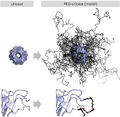 PegUricase enzyme illustration
_alternate.svg)


Medical Disclaimer: WikiMD is for informational purposes only and is not a substitute for professional medical advice. Content may be inaccurate or outdated and should not be used for diagnosis or treatment. Always consult your healthcare provider for medical decisions. Verify information with trusted sources such as CDC.gov and NIH.gov. By using this site, you agree that WikiMD is not liable for any outcomes related to its content. See full disclaimer.
Credits:Most images are courtesy of Wikimedia commons, and templates, categories Wikipedia, licensed under CC BY SA or similar.
Translate page: - East Asian
中文,
日本,
한국어,
South Asian
हिन्दी,
தமிழ்,
తెలుగు,
Urdu,
ಕನ್ನಡ,
Southeast Asian
Indonesian,
Vietnamese,
Thai,
မြန်မာဘာသာ,
বাংলা
European
español,
Deutsch,
français,
Greek,
português do Brasil,
polski,
română,
русский,
Nederlands,
norsk,
svenska,
suomi,
Italian
Middle Eastern & African
عربى,
Turkish,
Persian,
Hebrew,
Afrikaans,
isiZulu,
Kiswahili,
Other
Bulgarian,
Hungarian,
Czech,
Swedish,
മലയാളം,
मराठी,
ਪੰਜਾਬੀ,
ગુજરાતી,
Portuguese,
Ukrainian

