Pathophysiology of multiple sclerosis
The Pathophysiology of Multiple Sclerosis refers to the functional changes that occur in the body as a result of the disease Multiple Sclerosis (MS). MS is a chronic, inflammatory, autoimmune disease of the Central Nervous System (CNS), which includes the brain and spinal cord.
Disease Process[edit]
The disease process of MS involves an abnormal response of the body's immune system. This response is directed against myelin, the fatty substance that surrounds and insulates the nerve fibers, and the nerve fibers themselves. This process is referred to as demyelination.
Demyelination[edit]
In MS, the immune system attacks myelin, causing inflammation and damage. This damage disrupts the normal flow of electrical impulses along the nerve fibers, leading to a range of neurological symptoms. The exact cause of this immune-mediated response is unknown, but it is believed to involve a combination of genetic and environmental factors.
Lesions and Scarring[edit]
The areas of inflammation and demyelination in the CNS are visible on Magnetic Resonance Imaging (MRI) scans as areas of damage called lesions. Over time, these lesions can lead to the formation of scar tissue, a process known as sclerosis. This is where the disease gets its name.
Symptoms[edit]
The symptoms of MS vary widely and depend on the location and extent of the lesions in the CNS. Common symptoms include fatigue, difficulty walking, numbness or tingling, muscle weakness and spasms, poor balance and coordination, and problems with speech and swallowing.
Treatment[edit]
While there is currently no cure for MS, treatments are available to manage symptoms and slow the progression of the disease. These include disease-modifying therapies (DMTs), which aim to reduce the frequency and severity of relapses, and symptom management therapies, which aim to improve quality of life.
Research[edit]
Research into the pathophysiology of MS is ongoing, with the aim of better understanding the disease process and developing new treatments. This includes research into the role of the immune system, the process of demyelination and remyelination, and the genetic and environmental factors that may contribute to the development of the disease.
 | This medical article is a stub. You can help WikiMD by expanding the page. |
Pathophysiology of multiple sclerosis[edit]
-
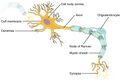 Diagram of a neuron
 -
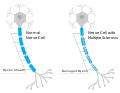 Illustration of myelin sheath damage in multiple sclerosis
 -
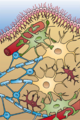 Types of glial cells


Medical Disclaimer: WikiMD is for informational purposes only and is not a substitute for professional medical advice. Content may be inaccurate or outdated and should not be used for diagnosis or treatment. Always consult your healthcare provider for medical decisions. Verify information with trusted sources such as CDC.gov and NIH.gov. By using this site, you agree that WikiMD is not liable for any outcomes related to its content. See full disclaimer.
Credits:Most images are courtesy of Wikimedia commons, and templates, categories Wikipedia, licensed under CC BY SA or similar.
Translate page: - East Asian
中文,
日本,
한국어,
South Asian
हिन्दी,
தமிழ்,
తెలుగు,
Urdu,
ಕನ್ನಡ,
Southeast Asian
Indonesian,
Vietnamese,
Thai,
မြန်မာဘာသာ,
বাংলা
European
español,
Deutsch,
français,
Greek,
português do Brasil,
polski,
română,
русский,
Nederlands,
norsk,
svenska,
suomi,
Italian
Middle Eastern & African
عربى,
Turkish,
Persian,
Hebrew,
Afrikaans,
isiZulu,
Kiswahili,
Other
Bulgarian,
Hungarian,
Czech,
Swedish,
മലയാളം,
मराठी,
ਪੰਜਾਬੀ,
ગુજરાતી,
Portuguese,
Ukrainian

