Ovarian fibroma
Ovarian fibroma is a type of benign tumor that originates from the ovary. It is the most common solid tumor of the ovary, accounting for approximately 4% of all ovarian neoplasms. Ovarian fibromas are composed of fibrous or connective tissue, and can occur at any age, but are most commonly diagnosed in women between the ages of 40 and 60.
Clinical Presentation[edit]
Patients with ovarian fibroma often present with abdominal pain and a palpable mass. In some cases, the tumor may be discovered incidentally during a routine gynecological examination. Other symptoms may include menstrual irregularities, bloating, and urinary frequency due to pressure on the bladder.
Diagnosis[edit]
The diagnosis of ovarian fibroma is typically made based on imaging studies, such as ultrasound, computed tomography (CT) scan, or magnetic resonance imaging (MRI). These tests can reveal a solid mass in the ovary. However, a definitive diagnosis can only be made through histopathological examination of the tumor tissue, usually obtained during surgery.
Treatment[edit]
The primary treatment for ovarian fibroma is surgical removal of the tumor. The type of surgery depends on the size and location of the tumor, as well as the patient's age and desire to preserve fertility. In some cases, only the tumor is removed (cystectomy), while in others, the entire ovary may need to be removed (oophorectomy). If the tumor is large or if there is suspicion of cancer, a hysterectomy may be performed.
Prognosis[edit]
The prognosis for ovarian fibroma is generally good, as these tumors are benign and do not spread to other parts of the body. However, recurrence can occur, especially if the tumor was not completely removed during surgery.
See Also[edit]
This gynecology related article is a stub. You can help WikiMD by expanding it.
 | This oncology article is a stub. You can help WikiMD by expanding the page. |
-
Ovarian fibroma under intermediate magnification
-
Fibroma of the ovary
-
Ultrasound image of ovarian fibroma
-
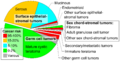 Ovarian tumors by incidence and cancer risk


Medical Disclaimer: WikiMD is for informational purposes only and is not a substitute for professional medical advice. Content may be inaccurate or outdated and should not be used for diagnosis or treatment. Always consult your healthcare provider for medical decisions. Verify information with trusted sources such as CDC.gov and NIH.gov. By using this site, you agree that WikiMD is not liable for any outcomes related to its content. See full disclaimer.
Credits:Most images are courtesy of Wikimedia commons, and templates, categories Wikipedia, licensed under CC BY SA or similar.
Translate page: - East Asian
中文,
日本,
한국어,
South Asian
हिन्दी,
தமிழ்,
తెలుగు,
Urdu,
ಕನ್ನಡ,
Southeast Asian
Indonesian,
Vietnamese,
Thai,
မြန်မာဘာသာ,
বাংলা
European
español,
Deutsch,
français,
Greek,
português do Brasil,
polski,
română,
русский,
Nederlands,
norsk,
svenska,
suomi,
Italian
Middle Eastern & African
عربى,
Turkish,
Persian,
Hebrew,
Afrikaans,
isiZulu,
Kiswahili,
Other
Bulgarian,
Hungarian,
Czech,
Swedish,
മലയാളം,
मराठी,
ਪੰਜਾਬੀ,
ગુજરાતી,
Portuguese,
Ukrainian


